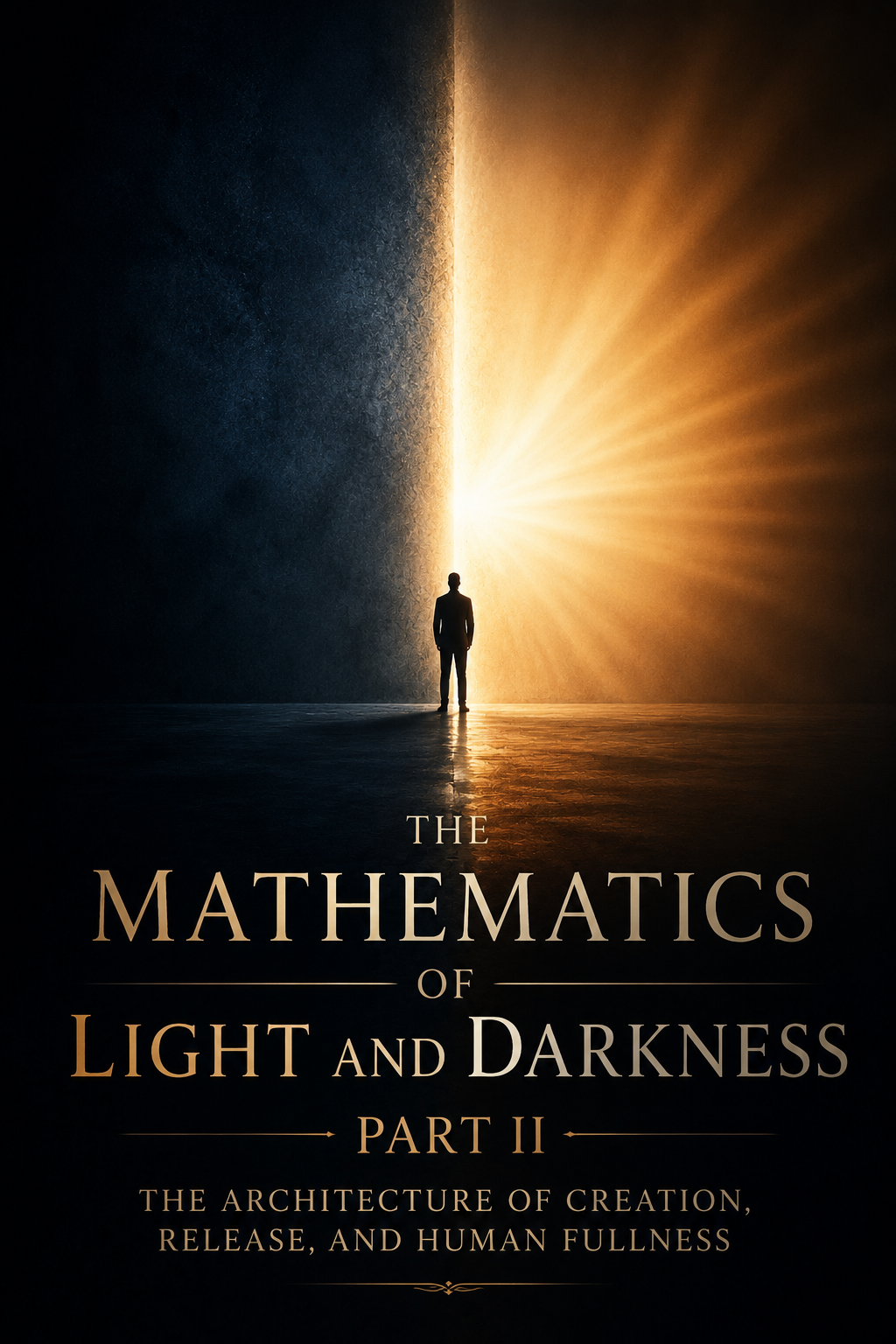
The Mathematics of Light and Darkness: Part II — The Architecture of Creation, Release, and Human Fullness
I. The Primordial Fallacy: Deconstructing Absolute Purity
Humanity has long been sold a counterfeit narrative: that light and darkness are mortal enemies locked in a war of total annihilation, and that to be whole, a person must utterly eradicate the shadow. Society worships a sanitized ideal of hyper-competence, relentless positivity, and unbroken strength.
Yet, both physics and metaphysics reveal a different reality. Absolute darkness and absolute light do not exist in isolated purity; they meet in the penumbra, the gradient, the living tension of the gray areas. Darkness is not an active, invading army—it is simply the space where light has not yet been named or focused. To demand the immediate banishment of shadow is to demand the destruction of the very womb in which light is conceived.
The CYTOG Principle: Human formation does not begin with the fantasy of perfection. It begins with accurate perception. The formed human being does not deny limitation, contradiction, vulnerability, uncertainty, grief, weakness, or incompleteness. He learns to distinguish what must be rejected from what must be understood, what must be healed from what must be disciplined, and what must be surrendered from what must be developed. Wholeness is therefore not the absence of complexity; it is the achievement of ordered complexity.
II. The Divine Paradox: Creation as an Act of Weakness
To understand creation, one must look past the illusion of static power and examine the mechanics of release.
If God is absolute, self-contained energy, then the act of creation—“Let us make man in our own image”—was not a flex of supreme dominance. It was an act of profound, vulnerable weakness. It was a contraction, a self-emptying (kenosis), a release of divine light so that something other than God could exist.
Existence operates on a strict law of biological and spiritual recycling:
Intake and Retention (Strength): The body takes in food, accumulating mass, energy, and resources. But if a man only takes in and never releases, he becomes toxic, stagnant, and blocked.
The Release (Weakness): To create, to give life, to clear space, there must be a discharge of that stored energy. A mother looks strong before conception, but when she carries and delivers new life, she experiences a profound depletion—pouring her own blood, calcium, and vitality into an extension of herself.
The Vacuum Principle: Creation requires an emptying. Without the release of stored strength, no new vacuum is created, and no fresh intake can occur. The universe moves forward not by hoarding power, but by the courageous vulnerability of releasing it.
The CYTOG Formation Principle: Strength is not adequately measured by how much a person can accumulate, retain, control, or display. A deeper measure of strength is the capacity to release what must be released without losing identity, direction, responsibility, or purpose. Giving, teaching, creating, mentoring, forgiving, serving, and transmitting knowledge all require forms of expenditure. Mature strength therefore includes the wisdom of expenditure.
III. The Microcosm of the Family and the Self: Light, Darkness, Strength, and Weakness
This divine architecture is mirrored directly within the human family and the individual soul.
The Family Mirror: In a single household, contrast is inevitable. One member carries the “light” and optimism, while another navigates the “shadow” or sorrow. One displays formidable strength, while another exposes raw, tender weakness. Families fracture when they demand uniformity and try to exile their weaker parts. They thrive only when they realize that the strong must protect the weak, and that the domestic unit is a gymnasium designed for the coexistence of opposites.
The Interior Civil War: Every human being carries this exact duality. The Apostle Paul—a titan of intellect and spiritual ascent who was caught up to the third heaven—confessed the eternal internal civil war: “The things I do not want to do are the things I find myself doing.”
The Gethsemane Blueprint: Even Jesus Christ, the God-man, faced his ultimate hour not with stoic, unfeeling power, but with raw, agonizing weakness in the Garden of Gethsemane. He cried, wept over the cup, and surrendered: “Not as I will, but as thou will.” His moment of absolute human frailty became the exact crucible through which ultimate strength was born.
The Formation Implication: Human maturity does not require the elimination of internal tension. It requires the development of a governing centre capable of holding tension without being destroyed by it. The human task is therefore neither to glorify weakness nor to worship strength, but to bring both under disciplined formation so that strength becomes protective rather than oppressive and vulnerability becomes instructive rather than incapacitating.
IV. The Path to Fullness: Embracing the Yin and Yang of Human Formation
Man reaches his fullest capacity not by splitting himself in two or pretending his shadow does not exist, but by integration.
When a man stops warring against his own limitations, his temper, his fears, and his capacity for error, the internal civil war ceases. He accepts the Yin and the Yang within his own breath—the dark soil of human frailty out of which the bright flower of resilience grows.
True human formation, the core of CYTOG, teaches us to stop running from our shadows and start mapping them. When weakness is acknowledged, brought into the light, and surrendered to a higher purpose, it ceases to be a liability. It becomes the very fuel of empathy, wisdom, and infinite creative capacity.
The Law of Integrated Fullness: A formed human being does not ask, “How do I become a person who has no darkness?” He asks, “What is this darkness, what produced it, what does it reveal, what must be transformed, and what can it teach me about the architecture of light?” The objective is not romanticized shadow, but illuminated understanding. Integration does not mean permitting every impulse to remain; it means bringing every significant dimension of the self into a field where it can be perceived, interpreted, governed, transformed, and directed toward life.
THE ARCHITECTURE OF INTEGRATED HUMAN FULLNESS
PERCEPTION → ACKNOWLEDGMENT → INTERPRETATION → INTEGRATION → GOVERNANCE → TRANSFORMATION → PURPOSE
CYTOG therefore rejects two incomplete architectures of human development: the architecture of denial, which attempts to destroy every uncomfortable dimension of the human person, and the architecture of indulgence, which treats every impulse, wound, limitation, or shadow as something that must simply be accepted without discipline.
Between these extremes stands the architecture of formation. Here, the human being learns to see accurately, name honestly, understand deeply, govern deliberately, transform progressively, and direct the whole person toward a coherent purpose.
Formation does not mean becoming less human. It means becoming more capable of governing what it means to be human.
THE CYTOG DECLARATION OF HUMAN FORMATION
On Light, Darkness, Strength, Weakness, Release, Integration, and Fullness
CYTOG HUMAN FORMATION AND LEARNING hereby establishes, for the purposes of its philosophical, educational, research, and formative architecture, that the human person must not be understood through simplistic binaries that divide existence into the categories of strength and weakness, light and darkness, success and failure, competence and limitation, or power and vulnerability without examining the relationships through which these realities become formative.
CYTOG declares that human fullness is not the achievement of absolute purity but the achievement of ordered integration. The mature person is not one who has eliminated every shadow, weakness, contradiction, uncertainty, or vulnerability, but one who has developed sufficient perception, understanding, self-regulation, discernment, agency, and moral direction to encounter these realities without being governed blindly by them.
CYTOG further declares that weakness must neither be worshipped nor despised. Strength must neither be idolized nor feared. Light must neither be reduced to superficial positivity nor darkness interpreted as automatic evil. Each reality requires examination within its proper context, consequences, relationships, and developmental meaning.
The purpose of human formation is therefore not cosmetic perfection. It is the construction of an interior architecture capable of receiving reality, interpreting reality, governing response to reality, and converting experience into wisdom, character, responsibility, creativity, and purposeful action.
Accordingly, CYTOG recognizes release as a formative principle. What is accumulated must sometimes be released. What is retained must sometimes be surrendered. What has served one season may need to be relinquished for another. Creation, growth, generosity, teaching, service, transformation, and renewal frequently require the courage to release what can no longer remain in its former configuration.
CYTOG also recognizes integration as a governing principle. The formed person does not fragment himself in order to appear whole. He brings his experiences, capacities, limitations, memories, emotions, relationships, convictions, failures, aspirations, and responsibilities into an increasingly coherent architecture of self-government.
Therefore, this document shall be understood not as a celebration of darkness, weakness, suffering, or limitation for their own sake, but as an inquiry into how the whole human person may be brought under intelligent formation. The objective is neither denial nor indulgence, neither repression nor surrender, but discerned integration under a higher governing purpose.
This is the CYTOG commitment: to study the human being as a forming being, to examine the architecture through which human capacities are developed, and to cultivate persons capable of transforming experience into wisdom and potential into responsible action.
“The purpose of formation is not to create a human being without shadow, but to form a human being capable of bringing what is hidden into understanding, what is weak into disciplined development, what is strong into responsible service, and the whole person into purposeful maturity.”
OFFICIAL AUTHORIZATION
This declaration forms part of the intellectual and formative architecture of CYTOG HUMAN FORMATION AND LEARNING. It is intended to establish the governing interpretive principle of this document: that human development is a process of perception, understanding, integration, governance, transformation, and purposeful action.
The principles expressed herein belong to the wider CYTOG project of constructing an interdisciplinary architecture for the study and formation of the human person across psychological, philosophical, educational, social, institutional, cultural, and spiritual dimensions.
Founding Author and Principal Architect:
John Ikechukwu Nwigbo (J.I.N.)
John Iyke | PulpitVoice | The Oracle of God
Education and Learning • Research and Knowledge • Institutional Integrity
Systems Architecture • Epistemological Frameworks • Structural Sovereignty
OFFICIAL CYTOG DOCUMENT • PHILOSOPHICAL AND FORMATIVE ARCHITECTURE
© CYTOG HUMAN FORMATION AND LEARNING NIGERIA LIMITED
Authorized Intellectual Architecture • J.I.N.

Leave a Reply