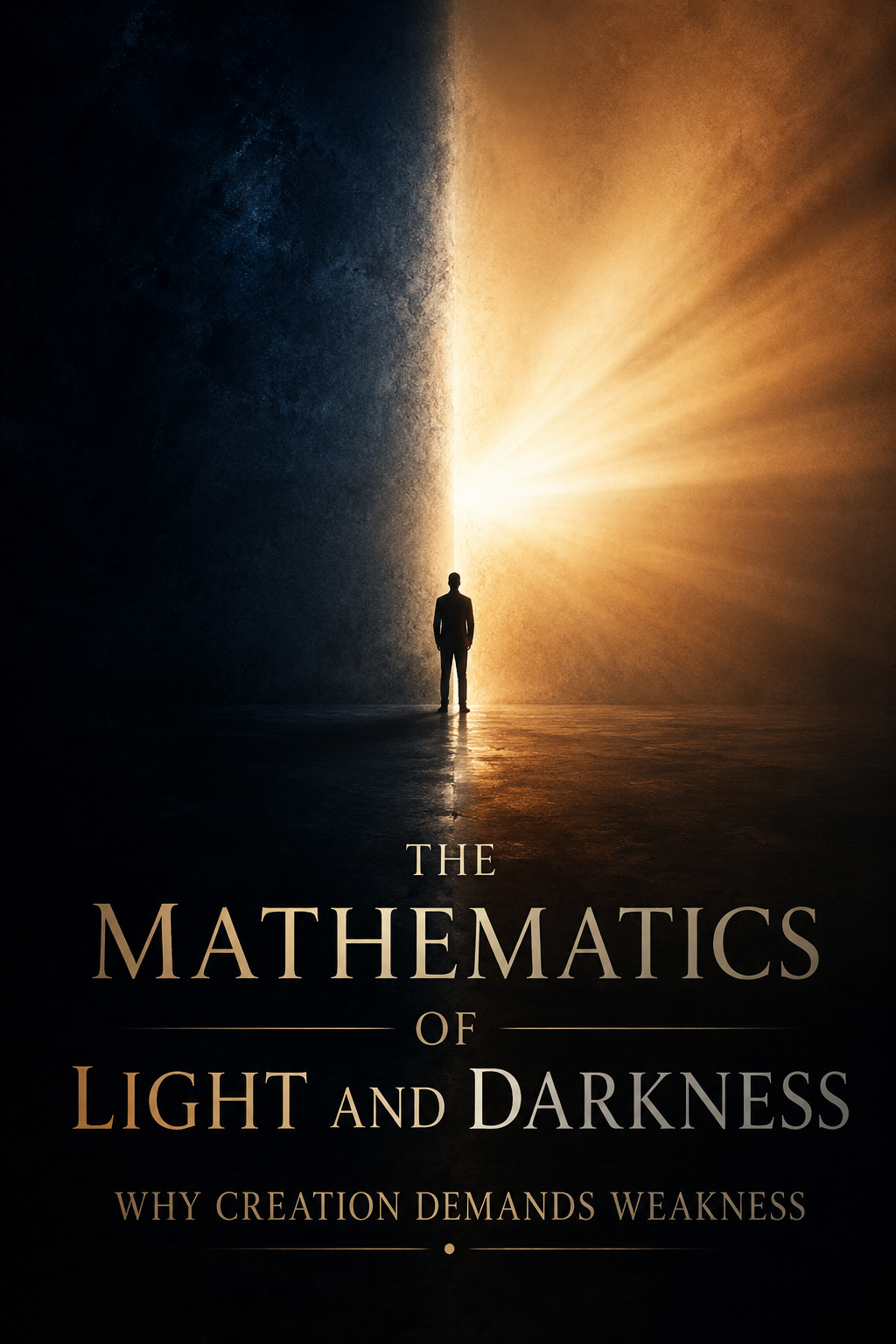
The Mathematics of Light and Darkness: Part I — Why Creation Demands Weakness
I. Introduction: The Myth of Absolute Exclusion
A. Deconstructing the Dichotomy: Challenging the naive assumption that light entirely annihilates darkness. Humanity has long been sold a counterfeit narrative: that light and darkness are mortal enemies locked in a war of total annihilation, and that to be whole, a person must utterly eradicate the shadow. Society worships a sanitized ideal of hyper-competence, relentless positivity, and unbroken strength.
B. Phenomenological Reality: Examining how human perception relies on the gradient (penumbra) rather than absolute binaries. Both physics and metaphysics reveal a different reality. Absolute darkness and absolute light do not exist in isolated purity; they meet in the penumbra, the gradient, and the living tension of the gray areas. Darkness is not an active, invading army—it is simply the space where light has not yet been named or focused. To demand the immediate banishment of shadow is to demand the destruction of the very womb in which light is conceived.
C. Core Thesis: Light and darkness do not exist in mutual destruction, but in a structured, generative coexistence that mirrors the realities of human consciousness, moral formation, and cosmic order.
II. The Metaphysics of Primordial Darkness and Created Light
A. The Ontological Priority of Darkness: Analyzing cosmological and scriptural narratives (e.g., Genesis) where darkness precedes light, establishing it not merely as a void, but as a foundational matrix. To understand creation, one must look past the illusion of static power and examine the mechanics of release. If God is absolute, self-contained energy, then the act of creation—“Let us make man in our own image”—was not a flex of supreme dominance. It was an act of profound, vulnerable weakness. It was a contraction, a self-emptying (kenosis), a release of divine light so that something other than God could exist.
B. Light as a Piercing Agent, Not an Annihilator: Redefining illumination as an introduction of distinction rather than the total erasure of the shadow. Existence operates on a strict law of biological and spiritual recycling: intake and retention representing strength, while release and self-emptying represent the necessary vulnerability of creation. Without the release of stored strength, no new vacuum is created, and no fresh intake can occur.
C. Mathematical and Physical Parallels: Utilizing wave-particle duality and shadow mechanics to demonstrate how opposing physical states occupy the same spatial continuum. The burning bush witnessed by Moses serves as the ultimate cosmic snapshot: a fire burning with absolute divine energy, yet the bush was not consumed because it was a created vessel holding an infinite force. God is creation, and creation is God in distributed form, stepped down so that life could exist without destroying its containers.
III. The Hermeneutics of Coexistence: The Parable of the Wheat and the Tares
A. Sociological and Theological Integration: Examining Matthew 13 as a framework for systemic coexistence rather than premature polarization. Just as the wheat and the tares grow side by side in the same field until the harvest, natural and human orders allow contrasting forces to occupy the same space temporarily without instant mutual destruction.
B. Temporal Suspension: Analyzing why the “time of selection” is deferred, and what this delay teaches human institutions about patience, tolerance, and moral complexity. Premature, heavy-handed attempts to violently purge every flaw, error, or opposing element often destroy the fragile good growing alongside it.
C. Anthropological Implications: Recognizing that human formation requires navigating a mixed reality—internal and external—where virtue and vice grow from the same soil until maturity. Within the family and the individual soul, contrast is inevitable; true maturity requires managing this internal civil war rather than demanding false uniformity.
IV. Cytogenic Human Formation and Paideia
A. Defining Cytog Human Formation: Integrating biological metaphors of cellular growth (cytology/cytogenesis) with human development, where growth happens through tension and environmental friction. Just as a seed must go down into the dark earth and lose its rigid form before it can rise, human formation relies on the descent into trial and the subsequent regeneration of capacity.
B. The Pedagogical Value of the Shadow: Why educational and philosophical systems fail when they attempt to sanitize the human experience of all darkness or struggle. When a man stops warring against his limitations, fears, and capacity for error, the internal civil war ceases, transforming apparent weakness into resilience and wisdom.
C. Integrative Learning: Cultivating a global mindset capable of holding paradox, fostering critical thinking, and synthesizing seemingly contradictory worldviews. True human capacity is achieved by embracing the divine tension of existence rather than fleeing into brittle perfectionism.
V. Philosophical Synthesis and Global Implications
A. Epistemological Humility: Acknowledging the limits of human perception in parsing absolute truth from constructed binaries. True wisdom begins when humanity accepts its finite vesselhood before the infinite architecture of the cosmos.
B. Cross-Cultural Parallels: Bridging Western analytical philosophy of light/darkness with Eastern ontological frameworks (e.g., Yin and Yang) regarding complementary opposites. Reality is universally governed by cooperative dualities rather than absolute mutual destruction.
C. Conclusion: Reimagining the department of philosophy’s role in guiding human formation through the embrace of structural complexity. Man reaches his fullest capacity not by splitting himself in two, but by integrating the light and the shadow into a unified, resilient whole.
“The shadow is not an insurgent enemy seeking the overthrow of light, but the essential maternal matrix without which illumination remains an abstraction devoid of a vessel.”
— John Ikechukwu Nwigbo (John Iyke | PulpitVoice | The Oracle of God)
CYTOG Human Formation and Learning • Department of Philosophy (2026)
CYTOG Human Formation and Learning Nigeria Limited
Knowledge • Structure • Formation | All Rights Reserved © 2026

Leave a Reply