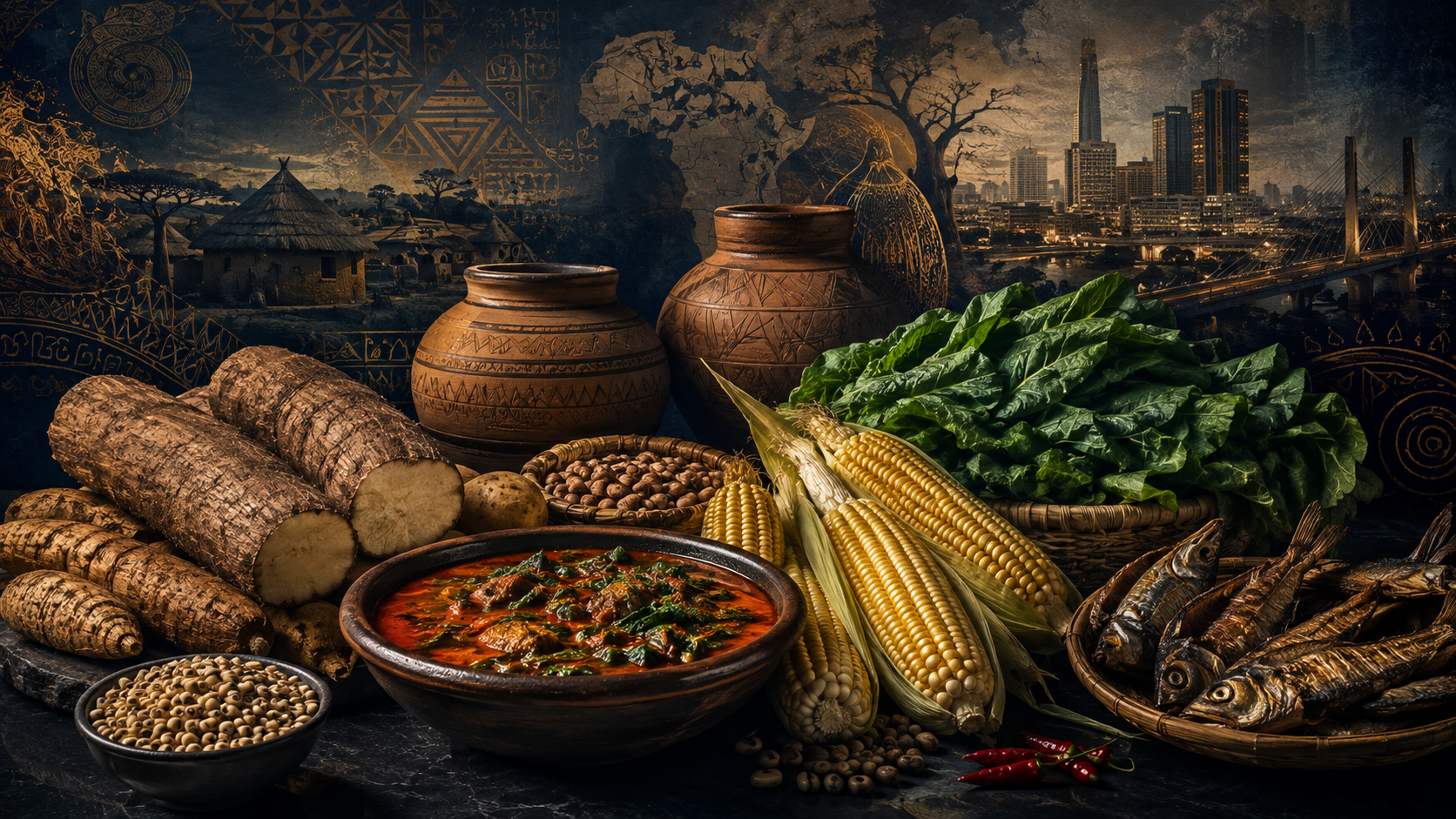
HUMAN FEEDING
AFRICAN AND NIGERIAN FOOD SYSTEMS
Purpose of the Investigation
The study of human feeding cannot be considered complete if Africa is treated merely as another geographical example.
Africa contains some of the world’s oldest and most diverse human food environments, shaped by different climates, ecologies, agricultural systems, cultures, technologies, trade networks and patterns of settlement.
Nigeria is particularly important because of its extraordinary ecological and cultural diversity. The country contains multiple agricultural zones and hundreds of ethnic and cultural food traditions. Consequently, there is no single historically uniform “Nigerian diet.”
The first methodological conclusion must therefore be:
Traditional African and Nigerian feeding must be studied as a plurality of food systems rather than as one homogeneous diet.
Contemporary research confirms substantial regional, socioeconomic and urban-rural variation in Nigerian dietary patterns. A systematic review of Nigerian diet literature and household survey data found that traditional Nigerian eating patterns remain heavily based on cereals, roots and tubers, while diets have been changing with increasing consumption of refined grains, processed foods, fats and sugars.
The purpose of this section is therefore not to idealize “African food” but to reconstruct its underlying nutritional, ecological and civilizational logic.
The Central Research Questions
This investigation will answer two major questions:
What nutritional logic was embedded within traditional African food systems before industrialization and the widespread availability of modern ultra-processed foods?
And:
How has the Nigerian food environment changed, and what consequences have followed?
These questions must be expanded into several subsidiary questions:
- What foods historically formed the foundation of African diets?
- How were carbohydrates, proteins, fats, fibre, vitamins and minerals obtained?
- How were foods combined into meals?
- How did ecological conditions determine available foods?
- How did agriculture shape dietary patterns?
- What role did fishing, hunting, livestock and gathering play?
- How were foods preserved?
- How did fermentation contribute to food systems?
- How did seasonal availability influence eating?
- How did food traditions differ between regions and peoples?
- What changed through colonialism and global trade?
- What changed through urbanization?
- What changed through industrial food production?
- What changed through refrigeration, supermarkets and fast food?
- What happened to traditional staples?
- What happened to refined grains, oils, sugar and processed foods?
- What nutritional problems existed historically?
- What nutritional problems are emerging today?
- Which traditional practices deserve preservation?
- Which traditional practices should not be romanticized?
- What can the Nigerian experience teach us about the broader principle of human feeding?
The Ecological Foundation of African Food Systems
Traditional food systems cannot be separated from geography.
Human beings eat what their environments permit them to produce, obtain, preserve and exchange.
Africa contains: rainforest zones; savannah; Sahel; wetlands; river systems; coastal environments; highlands; semi-arid regions; pastoral environments; agricultural regions.
Consequently, African diets developed through adaptation to radically different environments.
A rainforest community with access to plantains, roots, fruits, fish and forest resources could not have possessed exactly the same food system as a Sahelian community dependent more heavily on grains, legumes and livestock.
This leads to an important principle:
Traditional food systems are ecological adaptations before they are culinary traditions.
Culture then develops around what the environment provides.
Nigeria’s Major Food Foundations
The investigation should examine the major categories individually rather than treating them simply as a list of foods.
A. Roots and Tubers
Major examples include: yam; cassava; cocoyam; sweet potato and related tubers.
Roots and tubers have historically supplied substantial amounts of dietary carbohydrate.
They provide energy and, depending on the particular food and preparation, varying amounts of fibre and micronutrients.
But an important distinction must be made:
A staple carbohydrate is not necessarily a complete diet.
A food can be culturally central while still needing to be combined with other foods to provide broader nutritional adequacy.
This is why the traditional Nigerian pattern of combining staples with soups, vegetables, legumes, fish or meat deserves particular investigation.
Yam
Yam deserves individual attention because of its importance in many West African food systems.
It is not merely a food.
In several Nigerian societies, yam has historically been associated with: agriculture; land; household prosperity; masculinity; festivals; social status; communal identity.
Its importance therefore operates simultaneously at several levels: agricultural → nutritional → economic → social → cultural.
The research should investigate: varieties of yam; cultivation; storage; preparation; nutritional composition; portion patterns; accompanying foods; seasonal availability; ceremonial significance.
The objective is not to conclude that yam is inherently superior to other staples.
Rather:
What role did yam play within a balanced food system?
Cassava
Cassava represents another major component of Nigerian food history.
Its importance includes: high carbohydrate yield; adaptability to different environments; processing possibilities; storage and transformation into different food forms.
Cassava can be transformed into products such as: garri; fufu; other fermented preparations; flour; starch-based foods.
Fermentation and processing are particularly important because they demonstrate that traditional food preparation was not necessarily primitive or nutritionally irrelevant.
Traditional processing can alter: texture; digestibility; storage life; flavour; safety; nutrient availability.
Cassava also provides an important warning against romanticizing traditional foods: raw or inadequately processed cassava can contain cyanogenic compounds, making appropriate processing essential.
Thus:
Traditional food wisdom must be investigated at the level of preparation, not merely at the level of ingredients.
Plantain
Plantain provides another important carbohydrate source in many southern Nigerian and broader West African food systems.
It can be: boiled; roasted; fried; pounded; combined with other foods.
Its nutritional contribution varies according to maturity and preparation.
The investigation should therefore distinguish between the food itself and the culinary form in which it is consumed.
A boiled or roasted staple and a heavily fried preparation may have substantially different energy and fat characteristics.
This distinction will become increasingly important when examining the transition from traditional food systems to modern commercial food environments.
Grains
The major Nigerian grain systems include: maize; millet; sorghum; rice; wheat, increasingly important in modern diets.
Traditional grains such as millet and sorghum have particular importance in northern Nigerian food systems, while maize has become widespread.
The investigation should examine: whole versus refined grains; milling; fermentation; porridges; beverages; breads; grain mixtures; storage; seasonal production.
One important historical trend is the increasing importance of rice, maize and wheat alongside a relative decline in the consumption of some traditional grains such as millet and sorghum, particularly in urban and wealthier populations.
This is not automatically good or bad.
It is a dietary transition that requires nutritional evaluation.
Beans and Other Legumes
Legumes are especially important to the investigation because they can contribute: protein; fibre; minerals; complex carbohydrates.
Nigerian diets have traditionally incorporated legumes such as cowpeas and other beans in numerous forms.
They may be: boiled; cooked into stews; combined with grains; made into cakes; fermented; processed into other foods.
This is nutritionally significant because traditional diets based heavily on staples could achieve greater nutritional diversity when cereals or tubers were combined with legumes, vegetables and animal-source foods.
Nigeria’s major food crops include cassava, cowpea and sorghum, demonstrating the importance of these staple systems at national scale.
Vegetables and Leafy Greens
Traditional Nigerian soups and sauces provide an especially important field of investigation.
Commonly consumed vegetables and greens include: tomatoes; peppers; onions; okra; spinach; jute mallow; bitter leaf; waterleaf; cocoyam leaves; other indigenous leafy vegetables.
A review of Nigerian dietary patterns reports that vegetables are a significant component of Nigerian diets and that vegetable consumption has remained relatively high by international comparison.
This is important because the Nigerian meal structure often does not place vegetables as an isolated side dish.
Instead, vegetables may form the structural basis of the soup or sauce accompanying the staple.
That is a significant nutritional architecture.
Fruits
Traditional and contemporary Nigerian diets contain numerous tropical fruits, including: pawpaw; banana; oranges; tangerines; pineapple; watermelon; mango; coconut; guava.
The investigation should examine: seasonal availability; household consumption; local production; preservation; commercial availability; urban-rural differences.
Evidence reviewed in the Nigerian diet literature indicates that fruit consumption includes predominantly tropical fruits and has generally remained an important component of the Nigerian diet.
Fish
Fish deserves particular attention because Nigeria’s rivers, lakes, wetlands, coastal regions and lagoons have historically provided access to aquatic foods.
Fish can contribute: protein; essential fatty acids; vitamins; minerals.
Traditional preservation methods such as smoking and drying have historically extended availability beyond the immediate catch.
The investigation should therefore study fish not simply as a food but as part of a complete system: water ecosystem → fishing → preservation → trade → household consumption.
Meat and Animal Foods
Animal-source foods include: beef; goat; poultry; game; fish; eggs; dairy products in some regions.
Historically, access to animal foods varied significantly by: geography; wealth; pastoralism; religion; culture; season; household status.
Therefore, it would be inaccurate to assume that traditional Nigerians universally consumed large quantities of meat.
The available evidence indicates that animal-source foods have historically represented a relatively smaller proportion of the Nigerian diet compared with many higher-income countries, although their consumption has increased during the dietary transition.
This raises a particularly important question:
Does nutritional adequacy require large quantities of animal food, or can adequate nutrition be achieved through appropriately combined plant and animal sources?
That question belongs primarily to the biological and nutritional sections, but the Nigerian evidence provides an important case study.
Eggs
Eggs deserve separate treatment because they provide a concentrated source of several nutrients and have become increasingly incorporated into Nigerian diets.
The Nigerian dietary transition has included increased consumption of eggs and dairy products alongside other changes in animal-source food consumption.
The investigation should distinguish: traditional availability; modern commercial production; household poultry; affordability; cultural acceptance; frequency of consumption.
Fermented Foods
Fermentation is one of the most important areas for deeper research.
Traditional African food systems have used fermentation for: preservation; flavour development; improved storage; transformation of raw materials; reduction of certain antinutritional or toxic compounds; production of beverages and staple foods.
Examples across African food systems include fermented cereal products, cassava products and other foods.
This deserves special attention because it demonstrates that traditional food systems often contained sophisticated biological processing technologies.
The correct conclusion is not “Traditional fermentation is always healthier.”
The correct research question is:
What biological and nutritional effects did particular fermentation processes produce, and under what conditions?
Palm Products and Oils
Palm products have major historical importance in many Nigerian food systems.
These include: palm fruit; palm oil; palm kernel products.
Palm oil can provide substantial dietary energy and fat and has long been integrated into Nigerian cooking.
However, the investigation must distinguish between: the traditional role of palm products, quantity consumed, preparation methods, total dietary fat, modern commercial oils, frying practices, overall dietary pattern.
A traditional ingredient cannot be evaluated in isolation from the quantity and context in which it is consumed.
Soups and Sauces as Nutritional Architecture
One of the most important features of Nigerian food culture is the combination of a staple with a nutrient-rich soup or sauce.
A typical structure can involve: staple carbohydrate; vegetables; legumes and/or animal-source protein; fat/oil; water and seasonings.
This structure deserves careful nutritional investigation.
The staple supplies substantial energy.
The soup or sauce can provide: vegetables; protein; fat; micronutrients; fibre; flavour.
Consequently, a Nigerian meal should not always be evaluated by examining the staple alone.
The nutritional unit may be the combined meal.
The Traditional Nigerian Meal as a System
A major research proposition emerges:
The nutritional logic of traditional Nigerian food often lies not in any single food but in the combination of complementary food categories within the meal.
For example: yam + vegetable-rich soup + fish is nutritionally different from yam alone.
Likewise: grain + legumes + vegetables is different from refined grain alone.
Therefore, the investigation should move beyond the question “Is this traditional food healthy?” and ask “What role does this food perform within the complete dietary pattern?”
That is a much more scientifically defensible question.
- What Was Potentially Strong About the Traditional Pattern?
The evidence does not justify claiming that traditional Nigerian diets were universally optimal.
However, research suggests several potentially valuable characteristics.
Traditional Nigerian dietary patterns have generally been characterized by: substantial reliance on cereals and roots/tubers; meaningful consumption of vegetables; consumption of fruits; inclusion of legumes; relatively modest animal-protein consumption; relatively high carbohydrate and fibre intake; use of locally available foods.
The Nigerian diet review concludes that the traditional pattern was relatively healthy by international standards, while also documenting a transition toward greater consumption of energy-dense processed foods, fats and sugars.
This is a research finding, not yet a CYTOG dietary prescription.
- What Traditional Nigerian Food Systems Did Not Solve
A serious study must also identify historical limitations.
Traditional food systems could suffer from: seasonal food scarcity; inadequate food quantity; micronutrient deficiencies; food insecurity; inadequate protein availability in some populations; infectious contamination; food-storage losses; limited access to certain foods; nutritional vulnerability during drought or crop failure.
Therefore:
Traditional does not mean nutritionally complete.
The historical food system must be evaluated in its actual ecological and socioeconomic context.
The Nigerian Nutrition Transition
The modern Nigerian food environment has undergone substantial change.
The transition has been driven by interacting factors including: urbanization; changing incomes; globalization; changing work patterns; convenience; commercial food production; food marketing; supermarkets; fast-food outlets; increased eating outside the home; greater availability of refined foods; increased availability of sugar-sweetened products.
Research on Nigeria describes a transition away from diets dominated primarily by traditional grains and tubers toward greater consumption of refined carbohydrates, processed foods, fats and sugars.
The important point is that the transition is not simply “traditional → modern.”
It is “one food environment → another food environment.”
And the new environment changes what choices are available, affordable, convenient and socially attractive.
The Rise of Processed and Ultra-Processed Foods
Modern processing must be carefully distinguished.
Not all processing is harmful.
Traditional processing includes: milling; drying; cooking; fermentation; preservation.
Modern industrial processing can also perform useful functions.
The specific concern is the increasing prominence of ultra-processed foods (UPFs)—industrial formulations that may contain refined ingredients, additives and combinations of fat, sugar, sodium and other components designed for convenience, palatability and long shelf life.
Evidence from large epidemiological reviews has found associations between higher exposure to ultra-processed foods and several adverse health outcomes, including obesity, type 2 diabetes and cardiovascular and mortality outcomes. However, associations vary by outcome and the evidence base is not identical for every proposed effect.
Therefore the responsible CYTOG position should be:
Ultra-processing warrants serious nutritional scrutiny, but “processed” and “ultra-processed” must not be treated as interchangeable categories.
The Double Burden and Multiple Burden of Malnutrition
Nigeria presents an especially important case because nutritional problems do not move simply from “hunger” to “abundance.”
Different forms of malnutrition can coexist.
These include: undernutrition; stunting; wasting; micronutrient deficiencies; overweight; obesity; diet-related chronic disease.
Research describes Nigeria as experiencing a nutrition transition accompanied by a double burden of malnutrition, with undernutrition continuing while overweight and obesity increase.
This is extremely important for our eventual principle.
A universal feeding doctrine cannot simply say “Eat less.” For a food-insecure child, that could be disastrous.
Nor can it simply say “Eat more.” For someone consuming excessive energy from nutrient-poor foods, that could worsen the problem.
Therefore:
Adequate human feeding must be calibrated to the person’s actual nutritional condition and circumstances.
This principle will later connect directly to adaptation.
Food Environment Rather Than Individual Choice Alone
Modern Nigerian eating patterns cannot be explained entirely by personal discipline.
Food choices occur inside a food environment.
That environment includes: price; availability; advertising; convenience; location; working hours; transportation; food outlets; cultural preferences; household income; education; food preparation time.
Research on Nigeria’s food system emphasizes that food environments shape what foods people can access and choose, while urbanization and changing lifestyles have contributed to increased availability of energy-dense processed foods.
This produces an important human-formation principle:
The governance of eating is partly personal and partly environmental.
A person cannot exercise unlimited dietary freedom where healthy food is inaccessible, unaffordable or culturally displaced.
- What Has Been Lost?
The research should investigate whether the transition has weakened some valuable features of traditional Nigerian food culture, including: dependence on locally produced staples; seasonal eating; household cooking; communal meals; indigenous vegetables; traditional grains; legumes; traditional fermentation; local food knowledge; food preparation skills.
This should not be assumed.
It must be documented food system by food system.
The relevant question is:
Which elements of traditional food culture were nutritionally valuable, and which can be retained without rejecting legitimate benefits of modern food technology?
- What Has Been Gained?
A balanced investigation must also identify improvements associated with modernization.
Modern food systems can provide: greater food variety; improved food distribution; refrigeration; safer storage; fortification; improved food safety technologies; wider access to certain nutrient-rich foods; year-round availability; improved transportation; reduced dependence on local seasonal production.
Therefore, the objective cannot be to restore an imagined pre-industrial diet.
The better objective is:
To identify what is nutritionally sound in traditional food systems and combine it intelligently with what modern food systems genuinely improve.
The Emerging CYTOG Principle
The Nigerian case study is beginning to reveal an important distinction.
The answer to human feeding is probably not “Return to traditional food.”
Nor “Embrace modern food technology.”
Instead:
Retain the principles that support nourishment, diversity, adequacy, moderation, cultural sustainability and food quality, while rejecting practices—ancient or modern—that undermine those principles.
This is much stronger because it allows evidence to judge the practice rather than allowing historical age to judge it.
Preliminary Proposition: The African Food-System Lesson
The evidence examined so far supports the following preliminary proposition:
Traditional African food systems demonstrate that human nourishment can be organized around locally available staples combined with vegetables, legumes, fruits, animal or aquatic foods, fats and traditional processing methods, with substantial adaptation to ecology, season and culture. Their nutritional value should be evaluated as complete dietary patterns rather than by isolated foods.
A second proposition follows:
Nigeria’s dietary transition demonstrates that increasing food availability and dietary diversity do not automatically guarantee better nutrition. The composition, degree of processing, affordability, preparation, quantity and overall pattern of consumption remain decisive.
And a third:
The modern Nigerian food environment creates a new challenge of human governance: food is increasingly available in forms designed for convenience, affordability and palatability, while physical activity and traditional food structures may change simultaneously.
These are propositions to be tested against the broader biological and nutritional evidence—not conclusions to be imposed upon it.
The Deeper CYTOG Question
The Nigerian investigation brings us closer to the fundamental question of the entire project:
If human beings have successfully nourished themselves through radically different food systems, what is constant beneath the variation?
The answer cannot simply be yam. It cannot simply be rice. It cannot simply be three meals. It cannot simply be traditional food. It cannot simply be modern nutrition.
The deeper investigation must search for principles such as: adequacy; nutritional diversity; appropriate quantity; quality; moderation; adaptation; food safety; sustainability; self-governance; cultural continuity; responsible provision.
These principles can then be tested against Scripture, physiology, history and contemporary nutrition science.
Research Conclusion for This Section
The Nigerian evidence does not establish that there was one perfect traditional African diet.
It establishes something more useful.
Human food systems have historically been adaptive systems.
They adapted to: ecology, agriculture, season, availability, technology, household structure, culture, economics, religious practice.
Nigeria’s experience also demonstrates that dietary change can produce both gains and losses: greater diversity and access to some foods can coexist with increasing exposure to energy-dense processed foods and rising diet-related health problems.
Therefore, the emerging principle is:
Human feeding should not be governed by nostalgia for the past or fascination with the modern. It should be governed by the intelligent identification of what actually nourishes human life under the conditions in which human beings live.
That proposition will be tested much more rigorously when we enter the next major domain: Part VIII — Modern Nutrition Science, where we will move from historical observation to the biological question of what the human body actually requires from food, and what the strongest contemporary evidence tells us about adequacy, balance, diversity, moderation, meal composition, quantity and dietary quality.
Leave a Reply