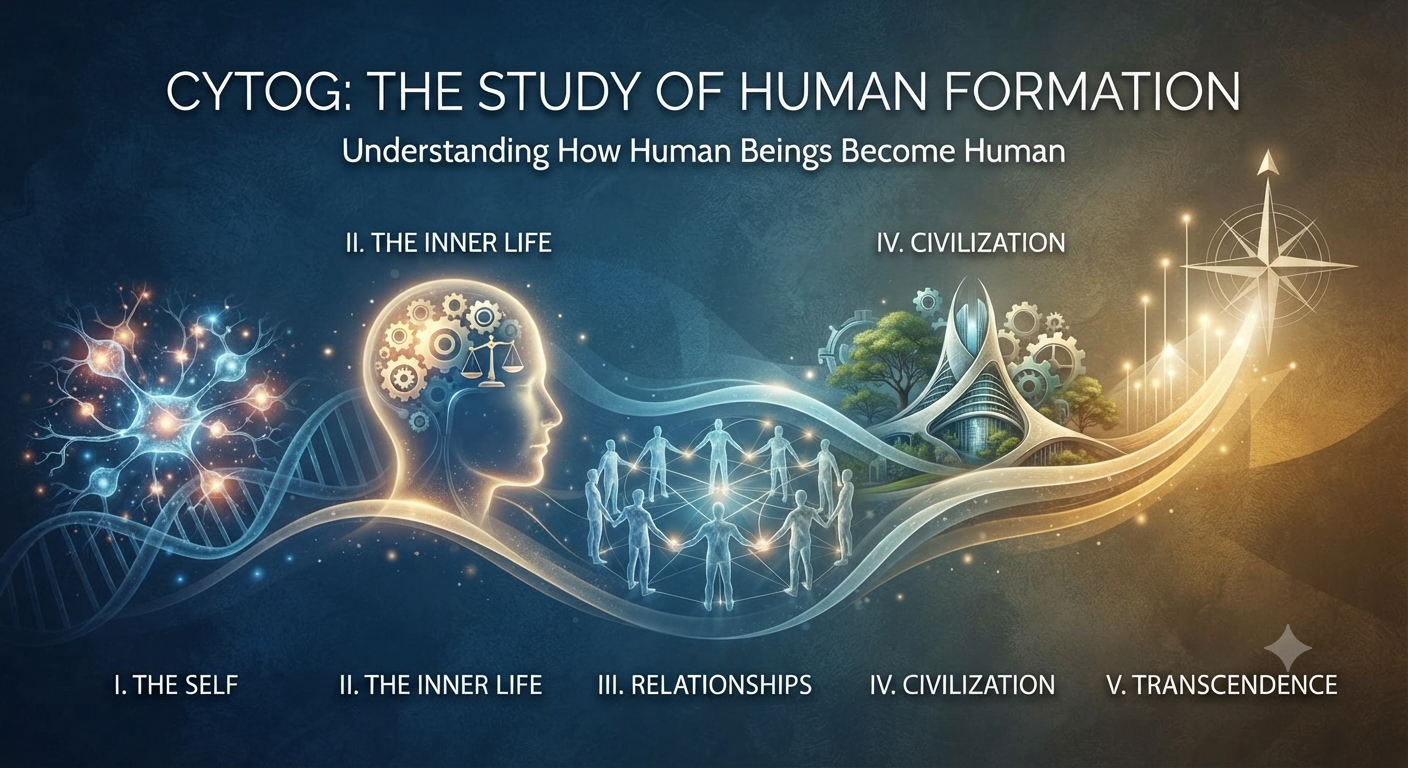
CYTOG: The Study of Human Formation
Why the Future of Humanity Depends on Understanding How Human Beings Become Human
Education has traditionally asked an important question:
What should a person know?
Psychology asks:
How does a person think, feel and behave?
Philosophy asks:
What is a human being, and how ought a person to live?
Theology asks:
What is humanity’s relationship with God and ultimate reality?
Sociology asks:
How are people shaped by society, culture and institutions?
History asks:
How did human beings and civilizations become what they are?
CYTOG brings these questions into a larger field of inquiry:
How does a human being become capable of living, thinking, relating, choosing, governing and contributing wisely?
This is the question of human formation.
HUMAN BEINGS ARE ALWAYS BECOMING
A human being is never simply what he or she is at a particular moment.
We are continually becoming.
Every experience leaves something behind. Every habit strengthens or weakens a pattern. Every decision contributes to character. Every relationship teaches something. Every environment influences development. Every institution participates in formation.
Even the ordinary use of time matters.
Every day is an opportunity.
Every hour of the day is an opportunity.
What a person does with each hour contributes, in some measure, to the person that individual is becoming.
This means that human formation cannot be reduced to classroom education.
- A person may acquire information without acquiring wisdom.
- A person may obtain qualifications without developing character.
- A person may become intellectually sophisticated while remaining emotionally immature.
- A person may become professionally successful without becoming capable of governing his or her own life.
The central concern, therefore, is not merely what has been learned, but what kind of human being the learning is producing.
WHAT IS CYTOG?
CYTOG Human Formation and Learning is an emerging intellectual and educational framework devoted to the systematic study of human formation.
Its concern is the whole human being.
CYTOG seeks to examine how human beings are shaped through knowledge, thought, perception, emotion, behaviour, relationships, culture, institutions, vocation, spirituality, history and lived experience.
Its work therefore crosses disciplinary boundaries.
Human formation cannot be adequately understood from a single academic discipline because the human being himself is not a single-dimensional reality.
A person is simultaneously biological, psychological, intellectual, relational, cultural, moral, vocational, social and spiritual.
CYTOG therefore approaches human formation as a whole-human inquiry.
FROM EDUCATION TO FORMATION
One of the fundamental distinctions within CYTOG is the distinction between education and formation.
Education can transfer knowledge.
Formation transforms capacity.
Education may teach a person what justice means.
Formation asks whether the person can actually practice justice.
Education may explain leadership.
Formation asks whether the individual can govern himself before attempting to govern others.
Education may teach communication.
Formation asks whether the individual has developed the character, perception and wisdom necessary to communicate responsibly.
Education may provide information about relationships.
Formation examines whether a person has become capable of relating with maturity, responsibility and dignity.
The difference is profound.
Education can fill the mind. Formation must shape the person.
THE CENTRAL QUESTION
At the heart of CYTOG is a foundational question:
How does a human being become capable of governing himself or herself wisely?
This question reaches far beyond self-discipline.
To govern oneself requires perception.
It requires understanding.
It requires agency.
It requires relational intelligence.
It requires adaptation.
It requires the ability to evaluate circumstances, interpret meaning, make decisions, regulate behaviour and accept responsibility for consequences.
CYTOG therefore identifies six fundamental human capacities:
- Perception. The capacity to notice, distinguish and accurately apprehend reality.
- Understanding. The capacity to interpret what has been perceived and develop coherent meaning.
- Governance. The capacity to regulate oneself and direct one’s conduct toward worthy ends.
- Agency. The capacity to act intentionally rather than merely react to circumstances.
- Relation. The capacity to participate responsibly in relationships, communities and institutions.
- Adaptation. The capacity to respond intelligently to changing conditions without losing essential principles.
These capacities provide an important framework for studying the development of the human person.
HUMAN FORMATION IS CUMULATIVE
Human beings inherit more than biological characteristics.
They inherit languages, stories, traditions, technologies, values, institutions, practices and accumulated knowledge.
Research on cumulative cultural learning demonstrates that human knowledge and practices are transmitted and modified across generations through processes such as observation, participation, imitation, exploration and instruction.
This gives human formation a civilizational dimension.
A child is born into a world that already exists. The child enters a family. A language is already waiting. A culture is already present. A religious or philosophical tradition may already exist. Institutions already have structures. Society already has expectations.
The individual does not begin formation from nothing. He or she enters an existing ecology of formation.
The great question becomes:
What is this environment forming?
THE FORMATION ENVIRONMENT
CYTOG therefore examines not only the individual but also the environments in which individuals are formed.
Family forms. Schools form. Religious communities form. Friendships form. Media forms. Technology forms. Workplaces form. Nations form. Economic systems form. Cultures form. Institutions form.
And increasingly, digital environments form human attention, habits and patterns of interaction.
This means that the responsibility for human formation cannot be placed entirely upon the individual.
If we want better human beings, we must also examine the systems and environments in which human beings are being formed.
THE FIVE DOMAINS OF HUMAN FORMATION
CYTOG’s broader intellectual architecture organizes human inquiry across five major domains:
I. THE SELF
The study of identity, embodiment, personal development, perception and the foundations of individual existence.
II. THE INNER LIFE
The study of cognition, emotion, character, consciousness, discipline, meaning and the internal processes through which a person becomes capable of self-governance.
III. RELATIONSHIPS
The study of family, friendship, intimacy, community, communication, cooperation, conflict and the responsibilities created by human relationships.
IV. CIVILIZATION
The study of culture, education, institutions, leadership, economics, governance, technology, history and the structures through which human beings organize collective life.
V. TRANSCENDENCE
The study of meaning, ultimate questions, spirituality, theology, morality, human destiny and humanity’s relationship with realities understood to transcend ordinary material existence.
Together, these domains create a broad field through which the human person can be studied as a whole.
WHY CYTOG MATTERS
- The world does not merely need more information. It needs people capable of using information wisely.
- It does not merely need more technology. It needs human beings capable of governing technology responsibly.
- It does not merely need more institutions. It needs people capable of building, sustaining and reforming institutions with wisdom and integrity.
- It does not merely need more educated individuals. It needs formed individuals.
The challenge of the coming generations is therefore not simply the accumulation of knowledge.
It is the formation of human capacity.
FROM KNOWLEDGE TO CAPACITY
CYTOG ultimately seeks to move the conversation from:
What do you know?
to:
What can you do with what you know?
From:
What have you been taught?
to:
What has your learning made you capable of becoming?
From:
What information do you possess?
to:
How does that information affect your judgment, character, relationships and conduct?
And ultimately:
What kind of human being is being formed?
This is the deeper question.
THE CYTOG VISION
CYTOG Human Formation and Learning exists around the conviction that humanity deserves a deeper science, philosophy and practice of becoming.
- Its intellectual task is to investigate the processes through which human beings develop.
- Its educational task is to translate that understanding into meaningful learning.
- Its research task is to examine the forces that shape individuals, communities and civilizations.
- Its practical task is to help develop people who are capable of perception, understanding, governance, agency, relation and adaptation.
- Its civilizational task is to ask whether the systems we build are producing the kind of human beings capable of sustaining them.
And its deepest question remains:
How does a human being become capable of governing himself or herself wisely?
Because every human life is a process of becoming.
Every day participates in that process.
Every hour participates in it.
Every choice participates in it.
And therefore, human formation is not something that happens only in school.
Human formation is happening all the time.
The question is whether we understand it well enough to participate in it deliberately.
Leave a Reply