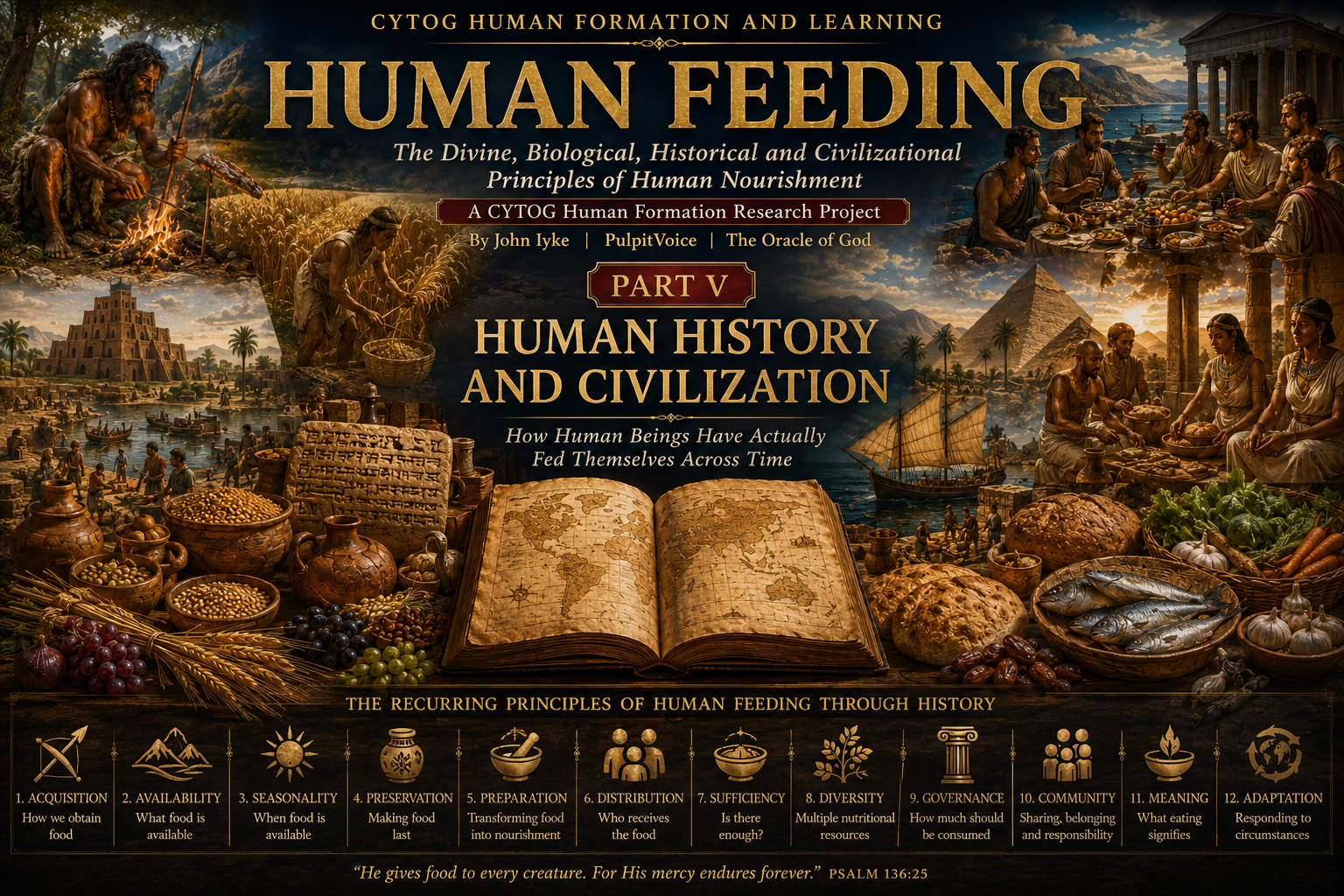
HUMAN FEEDING
HUMAN HISTORY AND CIVILIZATION
The biological investigation established that human beings possess universal nutritional requirements, but that the practical organization of feeding varies according to age, activity, environment, health, reproductive state, food availability and other circumstances.
Human history now gives us another body of evidence.
Before asking what human beings ought to do, we should examine what human beings have actually done.
This investigation is not an attempt to declare ancient practices automatically superior to modern ones. Nor is it an attempt to find a civilization whose diet can simply be copied.
The historical question is more fundamental:
Across the immense variety of human civilizations, environments and food systems, what recurring principles can be observed in the way human beings have obtained, prepared, distributed, preserved and consumed food?
That question matters because humanity has lived under radically different conditions: abundant environments and severe scarcity; tropical forests and Arctic regions; nomadic and settled societies; hunting and agriculture; pastoralism and fishing; subsistence economies and global trade; food scarcity and food surplus; communal ownership and private property; seasonal food availability and year-round food markets.
Yet human beings repeatedly developed systems capable of sustaining life within those environments.
The historical record therefore allows us to investigate whether there are deep patterns beneath cultural differences.
HUMAN FEEDING BEFORE AGRICULTURE
Hunter-Gatherer Societies
For most of human history, human beings lived as hunters, gatherers, fishers and mobile foragers rather than as industrial farmers.
This does not mean that there was one universal “hunter-gatherer diet.”
That idea must be rejected at the outset.
Hunter-gatherer populations occupied radically different environments, including: tropical forests; grasslands; deserts; coastlines; rivers; mountains; Arctic and sub-Arctic regions.
Consequently, the foods available to them varied enormously.
The first historical principle is therefore:
Human food systems have always been shaped by ecological circumstance.
Research on contemporary and historically documented hunter-gatherer populations demonstrates substantial variation in the relative importance of plant and animal foods. Earlier attempts to describe all hunter-gatherer diets using one generalized percentage are now recognized as oversimplifications.
More recent modelling likewise demonstrates that seasonality can substantially alter the composition of hunter-gatherer diets. In regions with short growing seasons, for example, animal foods could become more important.
This gives us our first major historical finding:
Human beings did not historically eat according to one universal menu; they ate according to what their environment could provide.
Food Availability
For a mobile forager, food was not necessarily available because a shop was open.
Food had to be: found; hunted; gathered; caught; transported; processed; and shared.
The relationship between food and environment was therefore direct.
A community’s diet could depend upon: rainfall; vegetation; animal migration; fish availability; fruiting seasons; tuber availability; hunting success; drought; floods; temperature; and geographical location.
Consequently, food availability itself could shape eating patterns.
This is fundamentally different from modern industrial food systems, where an individual can often obtain food independently of local season.
Historical proposition:
For most of human history, feeding was constrained by the ecological availability of food, and this constraint shaped both dietary composition and patterns of consumption.
Seasonal Eating
Seasonality is one of the most important findings for our research.
A modern supermarket can make strawberries, tomatoes, rice, bread, meat and imported fruit appear continuously available.
Ancient human beings did not generally possess this degree of year-round food availability.
A food could be abundant during one season and absent during another.
Therefore, human diets could change naturally across the year.
This means that:
Historical human feeding was often dynamic rather than nutritionally identical from January through December.
Research examining hunter-gatherer populations has specifically identified seasonality as an important factor shaping diet composition and human population ecology.
This is significant for our final project because it challenges the assumption that a human diet must necessarily remain identical every day of the year.
Periods Without Food
Hunter-gatherer life also demonstrates that human beings have historically experienced periods in which food was not immediately available.
A hunting expedition could fail. Gathering could produce little. Weather could interfere with acquisition. Seasonal scarcity could reduce available resources. Migration could be necessary.
This does not prove that deliberate fasting is inherently healthy.
That conclusion would require nutritional and medical evidence.
But historically it establishes something narrower:
Human beings have not always had continuous access to food, and human physiology developed within environments in which intervals of limited food availability occurred.
This becomes important when we later examine: fasting; meal frequency; time-restricted eating; food scarcity; and the biblical practice of fasting.
Hunting Success
Hunting introduces another important variable.
A successful hunt could produce a large quantity of valuable animal food.
A failed hunt could produce nothing.
The resulting food distribution therefore could not always be perfectly regular.
This unpredictability encouraged social mechanisms for sharing.
Research among hunter-gatherer populations documents systems of demand sharing, in which food acquired by individual hunters could be distributed across the wider group. Such systems helped buffer the uncertainty associated with acquiring difficult and unpredictable resources.
This produces an important civilizational insight:
Human feeding has historically been a social system, not merely an individual biological act.
Gathering
Gathering supplied another category of food.
Depending on the environment, this could include: fruits; roots; tubers; leaves; seeds; nuts; berries; insects; honey; mushrooms; and other edible resources.
The importance of gathered foods varied considerably among populations.
Therefore we should avoid romantic statements such as “The original human diet was primarily plants.” or “The original human diet was primarily meat.”
The evidence does not support one simple global formula.
The stronger conclusion is:
Human beings evolved food strategies capable of exploiting diverse ecological resources.
Mobility
Mobility fundamentally shaped food systems.
A mobile community cannot carry the same quantity of food-storage infrastructure as a settled agricultural society.
Mobility therefore influences: what can be transported; what can be preserved; what can be hunted; where people live; how food is shared; and how resources are accessed.
Research on hunter-gatherer societies identifies high mobility as closely connected with food-sharing systems and the management of unpredictable resources.
Historical proposition:
Human food systems adapt not only to what food exists, but also to how people live.
That principle will become increasingly important as civilization develops.
THE AGRICULTURAL REVOLUTION
Human feeding underwent one of its greatest transformations when populations increasingly adopted agriculture and animal domestication.
Agriculture did not simply produce “more food.”
It changed the entire architecture of human existence.
Humans began to: cultivate crops; domesticate animals; remain in more permanent settlements; store harvests; manage land; protect crops; accumulate surplus; trade food; and develop increasingly complex societies.
Research into animal domestication describes domestication as part of the transition from hunter-gatherer subsistence toward sedentary agricultural societies and the development of complex civilizations.
This is therefore a major turning point in the history of feeding.
ANCIENT AGRICULTURAL SOCIETIES
Agricultural societies developed around combinations of: cereals; legumes; vegetables; fruits; livestock; fish; oils; seeds; nuts; and other locally adapted foods.
The precise combination differed by environment.
But agriculture created something new:
The possibility of deliberately producing future food.
A hunter acquires food from an existing ecosystem.
A farmer increasingly attempts to shape the ecosystem so that food will be available later.
That difference is enormous.
Cereals
Cereals became central to numerous agricultural civilizations.
Examples include: wheat; barley; rice; millet; sorghum; maize in later regions of adoption.
Cereals were particularly valuable because many could be: cultivated at scale; dried; stored; transported; ground; cooked; fermented; and transformed into different foods.
This made them foundational to civilization.
Legumes
Legumes provided another important component of agricultural food systems.
Examples include: beans; lentils; peas; chickpeas; cowpeas; and other pulses.
Their historical importance is especially relevant because legumes can complement cereal-based food systems nutritionally while also contributing to agricultural sustainability.
FAO documentation on traditional African systems, for example, notes the importance of legumes alongside cereals and their role in enriching diets and supporting soil fertility through nitrogen fixation.
This suggests a recurring pattern:
Human agricultural systems often developed combinations rather than relying exclusively upon a single crop.
Vegetables, Fruits, Seeds and Other Plant Foods
Agricultural societies also cultivated diverse plant foods.
The precise selection depended upon: climate; soil; rainfall; technology; cultural preference; storage capacity; and trade.
This is important because civilization did not produce one agricultural diet.
It produced many agricultural food ecologies.
Livestock
Animal domestication transformed access to: meat; milk; eggs; hides; labour; manure; and transportation.
The domestication of sheep, goats, cattle, pigs and other animals fundamentally changed human subsistence patterns.
But domesticated animals were not necessarily consumed in unlimited quantities.
Animals could represent: wealth; labour; breeding stock; religious sacrifice; social status; emergency food reserves; or ordinary food.
Thus:
The presence of animals within a food system does not tell us how frequently their meat was eaten.
That distinction will matter when we investigate biblical meat consumption.
Food Storage
Agriculture creates another major requirement:
What happens between harvests?
A civilization must bridge the gap between production and consumption.
This produces the historical development of: granaries; drying; salting; smoking; fermentation; pickling; underground storage; sealed containers; and other preservation technologies.
Storage transformed food from something available now into something that could be preserved for later.
This is a major civilizational development.
Harvest Cycles
Agricultural societies became deeply connected to seasonal cycles.
Food production depended upon: planting; rainfall; growth; harvesting; threshing; processing; storage.
Consequently, agricultural calendars often became intertwined with: religious festivals; communal celebrations; labour patterns; taxation; trade; and social organization.
This will later be especially relevant to the biblical investigation because many biblical festivals are connected to agricultural cycles.
THE ANCIENT NEAR EAST
The Ancient Near East is especially important to this project because it provides much of the cultural environment in which the biblical food narratives emerged.
The region included civilizations with sophisticated systems of: agriculture; irrigation; animal husbandry; food storage; grain administration; trade; brewing; baking; and temple economies.
Therefore, biblical food practices should not be studied in isolation from the wider Near Eastern world.
Mesopotamian Evidence
Cuneiform documents provide unusually valuable evidence because administrative texts recorded food.
One surviving Neo-Sumerian tablet, for example, records rations of: beer; bread; oil; and onions for messengers.
This is significant because it moves our research beyond speculation.
We have documentary evidence showing that food could be: measured → allocated → recorded → distributed according to institutional requirements.
Food was therefore already part of organized economic systems.
Another Mesopotamian text preserves vocabulary for food and drink, demonstrating the sophistication of food classification and its relationship to ritual and institutional life.
Historical proposition:
In ancient civilization, food was not merely a household necessity; it became an object of administration, economic distribution, ritual and institutional organization.
EGYPT
Ancient Egypt provides particularly rich evidence for food production and distribution.
The Nile supported agricultural production, while Egyptian civilization developed extensive systems surrounding: grain; bread; beer; vegetables; fruits; fish; livestock; food storage; markets; labour rations; and religious offerings.
The British Museum’s reconstruction of ancient Thebes describes grain and barley as staples, with bread made from emmer wheat and barley, alongside fruits, vegetables, lentils, fish and various meats.
But one of the most important observations concerns social differentiation.
Meat was available, but it was not necessarily consumed with the same frequency across all levels of society. The British Museum notes that meats such as goose, duck, ox and goat were available, while some were more associated with special occasions.
This demonstrates something important:
Food availability does not equal universal food consumption.
Economic status influences what people can eat and how frequently.
Bread and Beer in Egypt
Bread and beer were particularly important.
Archaeological and textual evidence indicates that beer was treated as a significant food source and could form part of labour rations.
A translated Egyptian literary text also describes daily provisions of grain being transformed into bread and beer for household sustenance.
This demonstrates another recurring principle:
Ancient people often transformed staple agricultural products into durable or consumable forms rather than eating crops directly from the field.
Thus food preparation was part of the food system itself.
Social Class
Egypt also demonstrates the relationship between food and social hierarchy.
Different classes could experience different: quantities; qualities; varieties; access to meat; access to imported goods; and opportunities for feasting.
This is a recurring historical pattern.
Food has always been both “a biological necessity” and “a social marker.”
ISRAEL
Ancient Israel should receive special attention because it connects our historical investigation directly to the biblical material already examined.
Israelite food systems existed within an agricultural environment characterized by: grain; grapes; olives; figs; dates; legumes; vegetables; livestock; fish in relevant regions; milk products; and other local foods.
The biblical record itself repeatedly connects food with: agriculture; harvest; household life; hospitality; festivals; sacrifice; poverty; abundance; famine; and divine provision.
This makes Israel particularly valuable for understanding the relationship between food and theology.
Household Meals
Food in ancient Israel was not simply individual consumption.
Meals could be connected with: family; guests; covenant; celebration; mourning; hospitality; religious observance.
This means that the question “What did one person eat?” is sometimes less historically meaningful than “How did the household or community organize food?”
Festivals
Israel’s agricultural calendar was deeply connected with religious life.
Harvests were not merely economic events.
They became occasions for: thanksgiving; offerings; feasting; communal gathering; remembrance.
This is particularly important for CYTOG because it demonstrates that food can simultaneously serve biological, social, economic and religious functions.
Preservation
The need to preserve food would have been essential in an agricultural society.
Grains could be stored. Fruits could be dried. Certain foods could be salted or otherwise preserved. Fermentation could transform and extend the usability of food.
Therefore, ancient food systems cannot be understood simply by listing fresh foods.
The real food architecture includes: production + preparation + preservation + distribution + consumption.
GREECE
Ancient Greece provides another important contrast.
Greek food culture developed around foods such as: grains; olives and olive oil; grapes and wine; vegetables; legumes; fish; and other animal products.
But Greek civilization also developed highly structured social eating.
The famous symposium was not simply dinner.
It was a socially organized gathering centered on drinking, conversation and entertainment. The Metropolitan Museum describes the symposium as an established institution in Greek society and notes its connection with social interaction and intellectual discussion.
This demonstrates that:
Eating and drinking can become institutions of civilization.
Food and Philosophy
Greek civilization also provides an important philosophical dimension.
Questions of: moderation; self-control; pleasure; appetite; discipline; bodily training became part of broader Greek thought.
This is valuable for our later investigation because it shows that the problem of eating has never been merely nutritional.
Human civilizations have long asked: How much pleasure should a human being permit himself? How should appetite be governed? What constitutes excess?
These questions overlap strongly with the eventual CYTOG concept of governance.
Meal and Social Structure
Greek eating patterns were also influenced by social class and gender.
The symposium, for example, was principally a male aristocratic institution rather than a universal daily eating pattern for the entire population.
This is another warning against historical overgeneralization:
A documented practice among an elite group is not automatically the ordinary practice of an entire civilization.
ROME
Roman civilization developed one of the ancient world’s most elaborate food cultures.
Rome possessed: agriculture; livestock; fisheries; extensive trade networks; markets; preserved foods; imported foods; and sophisticated cuisine.
Food could travel considerable distances through the Roman economic system.
This produced a major transformation:
Trade could separate food consumption from local food production.
That principle will later become extremely important when we investigate modern civilization.
Roman Meal Structures
Roman dining also had recognizable structures.
The Metropolitan Museum describes the cena as the main dinner and identifies elaborate multi-course meals in elite contexts, including appetizers, main courses and desserts.
However, the historical record also shows that these elaborate banquets belonged particularly to wealthier social groups.
Therefore:
Elite feasting cannot be treated as representative of ordinary Roman nutrition.
Feasting
Roman elite banquets could include: exotic meats; shellfish; birds; wild game; elaborate desserts; expensive wines; and spectacular presentations.
Food therefore became a demonstration of: wealth; status; hospitality; political influence; and social power.
The Metropolitan Museum explicitly describes elite Roman banquets as sensory spectacles in which hosts sought to impress guests through food, tableware and entertainment.
This gives us another recurring principle:
Human beings use food not only to sustain life but also to communicate status and relationship.
AFRICA
Africa cannot be treated as a single food culture.
The continent contains enormous ecological and cultural diversity.
We therefore need to distinguish: North Africa; West Africa; Central Africa; East Africa; Southern Africa; Sahelian systems; rainforest systems; savanna systems; pastoral systems; fishing communities; agricultural societies.
The food systems of a Sahelian pastoralist cannot simply be equated with those of a rainforest farming community.
West Africa
West African traditional food systems developed around locally adapted crops and ecological conditions.
FAO documentation describes regional food systems involving crops such as: rice; millet; sorghum; maize; legumes; and indigenous varieties.
It also emphasizes the interaction between crops and ecological zones.
This is extremely important for our project.
Traditional food was not simply selected according to taste.
It was shaped by: soil + rainfall + climate + agriculture + culture + availability.
Traditional Nigerian Food Systems
Nigeria provides a particularly rich example because its ecological zones support different food traditions.
FAO documentation describes Nigerian traditional foods as varying according to climate and agro-ecological zone and identifies locally produced staples including: cassava; yam; cocoyam; sweet potatoes; plantains; maize; alongside accompanying foods and relishes.
This means that a Nigerian food system historically emerged from the relationship between: land → climate → crops → farming → preparation → household consumption.
Cereals and Legumes in West Africa
The combination of cereals and legumes is particularly important.
FAO documentation on West African savanna agriculture identifies: rice; millet; sorghum; maize; legumes as important components of regional agricultural systems, while noting the nutritional and agricultural significance of legumes.
This illustrates a broader historical principle:
Traditional food systems frequently combine complementary food sources rather than relying on a single category.
Central Africa and Rainforest Systems
Central African food systems developed within different ecological conditions.
Rainforest environments provide: plantains; cassava; yams; fruits; leafy vegetables; nuts; seeds; fish; wild foods; and other resources.
The point is not to create a romantic “African diet.”
It is to observe how people adapted their feeding systems to their ecological environments.
Sahelian Systems
The Sahel demonstrates another form of adaptation.
Food systems must contend with: irregular rainfall; drought; pastoral movement; seasonal production; and fragile ecological conditions.
This produces different relationships between: livestock; grains; water; migration; storage; and trade.
Thus:
The human feeding system must often adapt not merely to the body but to the ecology that supports the body.
ASIA
Asia contains some of the world’s oldest and most sophisticated agricultural food systems.
Its immense diversity includes: rice-based systems; wheat-based systems; millet systems; legumes; vegetables; fish; soy; fermented foods; fruits; tea; spices; and many other foods.
Rice became especially important across large parts of Asia.
FAO notes the enormous historical and contemporary importance of rice in Asian food systems and describes rice-based combinations including rice-legume, rice-fish, rice-livestock and rice-wheat systems.
This illustrates another important principle:
Traditional agricultural systems often integrated multiple species into a food-producing ecology rather than treating crops as isolated commodities.
Preservation and Fermentation
Asian food traditions also provide extensive evidence of preservation through fermentation.
FAO documentation describes traditional fermentation of: rice; cereals; vegetables; fruits; fish; meat; and other foods.
Fermentation could contribute to: preservation; flavour; texture; and, depending on the product, nutritional value.
This is historically significant because preservation allowed human beings to extend food availability beyond the period in which the food was naturally abundant.
Traditional Diversity
FAO has also documented the enormous diversity of traditional and neglected food crops across Asia and warned that modernization, monocropping and economic incentives can reduce agricultural diversity.
This gives us a major historical lesson:
Civilization can increase food production while simultaneously reducing biological and dietary diversity.
That is a crucial issue for the later examination of industrial food systems.
EUROPE
European food history demonstrates the interaction between: agriculture; climate; class; preservation; trade; war; famine; religion; and eventually industrialization.
Historically important foods included combinations of: grains; legumes; vegetables; fruits; dairy; meat; fish; oils; and fermented beverages.
But European food patterns were not static.
They changed dramatically when: new crops arrived from other continents; trade expanded; urbanization increased; preservation technology improved; industrial agriculture developed; and food processing became mechanized.
This brings us to one of the greatest transitions in human feeding.
THE PRE-INDUSTRIAL FOOD SYSTEM
Before modern industrialization, the relationship between human beings and food was generally much more direct.
A household or community might: grow → harvest → store → process → cook → eat.
Food production was physically visible.
The seasons mattered. The harvest mattered. Weather mattered. Preservation mattered. Labour mattered. Food waste could have serious consequences.
This does not mean pre-industrial food systems were healthier in every respect.
They also experienced: famine; infectious disease; nutrient deficiencies; food insecurity; crop failure; spoilage; and limited dietary variety.
Therefore:
Historical simplicity must not be confused with nutritional superiority.
This principle will be essential when we compare ancient and modern systems.
INDIGENOUS CIVILIZATIONS
Indigenous food systems across the world provide another major source of evidence.
These systems frequently demonstrate deep relationships between: land; water; animals; plants; seasons; spiritual beliefs; communal responsibilities; and food.
Modern FAO research on Indigenous Peoples’ food systems emphasizes that traditional foodways depend substantially upon access to functioning territories and ecosystems and that disruption of land and resource access can undermine traditional food systems, knowledge transmission and food security.
This is extremely important.
It means that food cannot always be separated from the ecological system that produces it.
Seasonal Adaptation
Indigenous food systems frequently developed around seasonal cycles.
People learned: when plants became available; when animals migrated; when fish spawned; when crops should be planted; when food should be harvested; and how to preserve surplus.
This represents accumulated ecological knowledge.
Historical proposition:
Human societies have historically survived not by ignoring environmental cycles, but by learning how to adapt their food systems to them.
Communal Eating
Another recurring pattern is communal food.
Food could be: shared; distributed; exchanged; offered to guests; used in rituals; given to vulnerable members; or consumed collectively.
This means that the individualistic concept “My food is simply my private biological property” does not adequately describe much of human history.
Food has historically been one of the principal mechanisms through which communities express: belonging; generosity; hospitality; obligation; reciprocity; celebration; and solidarity.
FOOD PRESERVATION AS A CIVILIZATIONAL TECHNOLOGY
Across civilizations, one recurring problem appears:
Food is often available at one time but needed at another.
Human beings responded with preservation.
They developed: drying; smoking; salting; fermentation; pickling; storage; cooling; underground storage; oil preservation; grain storage; and other methods.
This is one of the most important discoveries in the historical investigation.
Human civilization did not simply learn how to obtain food.
It learned “how to make food last.”
That ability reduced the dependence of human survival upon immediate food availability.
It therefore helped create: settlements; armies; cities; trade; states; long-distance travel; and complex economies.
FOOD AND TRADE
Another enormous transformation was the separation of food production from food consumption.
At the beginning: the person who eats is often close to the person who produces.
As civilization develops: the producer and consumer become increasingly separated.
Trade allowed foods to travel.
Roman civilization provides an early example of extensive food culture supported by trade and imported goods, particularly among elites.
Modern civilization has taken this principle to an extraordinary level.
Today, one person’s meal may contain foods produced in another region; another country; another continent.
This has radically altered human feeding.
FOOD AND SOCIAL CLASS
Across civilizations, food repeatedly reflects social inequality.
The poor may have: staple grains; roots; legumes; seasonal vegetables; limited animal foods.
The wealthy may have: greater variety; imported foods; more meat; more spices; elaborate desserts; larger quantities; and ceremonial feasts.
Ancient Egypt provides evidence of distinctions in access to foods such as meat, while Roman elite banquets demonstrate the extraordinary culinary abundance accessible to wealthy households.
Thus:
A civilization’s richest food culture does not necessarily represent the diet of its population.
This is essential when interpreting historical sources.
FOOD AND RELIGION
Across human civilizations, food repeatedly enters religious life.
It may become: sacrifice; offering; festival food; forbidden food; sacred food; fasting discipline; communal meal; hospitality; or ritual symbol.
The biblical tradition is therefore not unique in connecting food with religion.
What is distinctive about Scripture must be determined through theological investigation, but historically we can establish:
Human beings have consistently attached meaning to food beyond its nutritional function.
Food can communicate who we are, what we believe, whom we worship, with whom we belong, what we celebrate, what we refuse, and what we remember.
FOOD AND HOSPITALITY
Hospitality is another recurring civilizational pattern.
To feed a guest is often to communicate “You are welcome here.”
This is particularly visible in traditional societies where food production requires substantial labour and resources.
Offering food therefore represents more than giving calories.
It can communicate: honour; friendship; protection; peace; generosity; social obligation.
This will later become particularly important when we examine biblical meals and hospitality.
FOOD AND CELEBRATION
Human beings rarely reserve food exclusively for survival.
They also eat to celebrate: births; marriages; harvests; victories; religious festivals; communal achievements; political occasions; funerals and memorials.
Thus:
Feasting is a recurring human institution.
The problem therefore cannot be “Is eating for pleasure wrong?”
The more precise question is “When does legitimate pleasure become destructive excess?”
That question belongs simultaneously to biology, psychology, ethics, theology and civilization.
FOOD AND LABOUR
Food systems have always been connected with work.
Agricultural civilizations required enormous labour to: plant; weed; harvest; thresh; grind; cook; preserve; transport.
Food therefore provided not only nutrition but also the energy necessary to perform the work required to produce more food.
This creates a recurring cycle:
Food → energy → labour → food production → food.
Modern industrialization dramatically disrupted this relationship.
Mechanization reduced the amount of physical labour required to produce and transport food.
At the same time, industrialized societies made calorie-dense foods increasingly accessible.
This creates one of the most important transitions we will need to examine later:
Human food environments changed faster than human biology.
That proposition must be investigated carefully in the modern nutrition section.
FROM LOCAL FOOD TO INDUSTRIAL FOOD
The historical movement toward industrialization introduced profound changes.
Food increasingly became: standardized; processed; packaged; transported; marketed; refrigerated; preserved chemically or industrially; and made continuously available.
This produced enormous advantages: greater food security in many settings; reduced spoilage; greater variety; year-round availability; easier transport; and mass distribution.
But it also introduced new questions: excessive processing; high energy density; added sugars; excess sodium; refined carbohydrates; food marketing; continuous availability; larger portions; and reduced dependence upon seasonality.
These questions belong primarily to Part X, where modern nutrition science will examine them rigorously.
We should not prejudge the answer here.
WHAT HUMAN HISTORY DOES NOT PROVE
Historical research must be disciplined.
We must reject several tempting but invalid arguments.
Argument 1: “Ancient people ate X, therefore X is healthy.” Invalid. Historical consumption does not prove biological optimality.
Argument 2: “Our ancestors did not eat X, therefore X is unhealthy.” Also invalid. Historical absence does not establish biological harm.
Argument 3: “A traditional population was healthy, therefore its entire diet caused the health outcome.” Invalid. Health is affected by activity, genetics, infection, environment, socioeconomic conditions, smoking, alcohol, healthcare, lifespan, and many other factors.
Argument 4: “One civilization ate twice daily, therefore two meals are the natural human pattern.” Invalid. A civilization’s meal pattern is evidence of a cultural practice, not automatically a biological law.
Argument 5: “Ancient people ate seasonally, therefore modern people must eat seasonally.” Not necessarily. It may generate a legitimate research question, but not a conclusion.
THE CENTRAL HISTORICAL DISCOVERY
After comparing these civilizations, something remarkable begins to emerge.
Human beings have eaten extraordinarily different foods.
Yet beneath those differences, recurring structural principles appear.
Across hunter-gatherers, agriculturalists, ancient civilizations, Indigenous peoples and traditional food systems, human beings repeatedly had to solve the same fundamental problems:
- ACQUISITION — How do we obtain food?
- AVAILABILITY — What food is available in this environment?
- SEASONALITY — When is that food available?
- PRESERVATION — How do we make it last?
- PREPARATION — How do we transform it into usable food?
- DISTRIBUTION — Who receives the food?
- SUFFICIENCY — Is there enough?
- DIVERSITY — Can the food system provide different nutritional resources?
- GOVERNANCE — How much should be consumed?
- COMMUNITY — How is food shared?
- MEANING — What does eating signify?
- ADAPTATION — How does the food system respond to environmental and human circumstances?
These are far deeper than any particular menu.
THE HISTORICAL PRINCIPLE OF ADAPTATION
One of the strongest findings from this investigation is adaptation.
Hunter-gatherers adapted to ecological availability. Agriculturalists adapted crops to climate and soil. Pastoralists adapted livestock systems to grazing environments. West African societies developed food systems appropriate to their agro-ecological zones. Asian societies developed rice-based and other agricultural systems appropriate to their environments. Indigenous peoples developed foodways linked to territories and seasonal ecosystems.
Therefore:
Human feeding has historically been an adaptive relationship between the human organism and its environment.
This does not mean that everything humans adapt to is healthy.
It means adaptation is an enduring characteristic of human food systems.
THE HISTORICAL PRINCIPLE OF DIVERSITY
A second recurring pattern is diversity.
Not every society had the same foods.
But many successful food systems combined multiple sources: cereals; legumes; vegetables; fruits; animal foods; oils; seeds; nuts; fish; fermented foods.
The exact combination varied.
The principle of food-system diversity repeatedly appears.
This corresponds strikingly with modern nutrition’s emphasis on dietary diversity, although we must not confuse historical observation with scientific proof.
The historical record tells us:
Human societies have repeatedly depended upon combinations of foods rather than one universal food.
THE HISTORICAL PRINCIPLE OF MODERATION
Historical civilizations also demonstrate both abundance and excess.
Roman elite feasts demonstrate extraordinary abundance.
Greek philosophy considered questions of moderation and self-control.
Religious traditions developed fasting.
Agricultural societies experienced scarcity.
Thus humanity has historically lived at both extremes: “too little” and “too much.”
The question of moderation is therefore not a modern invention.
It is a permanent human problem.
THE HISTORICAL PRINCIPLE OF FOOD AS COMMUNITY
Food repeatedly appears as a social institution.
People: hunt together; harvest together; cook together; eat together; feast together; distribute food; feed strangers; feed the poor; celebrate with food; mourn with food; worship with food.
The human feeding system is therefore inherently relational.
This is especially relevant to CYTOG because human formation itself is relational.
Food is one of the earliest ways human beings experience: care, provision, belonging, trust, reciprocity, hospitality, and responsibility.
THE HISTORICAL PRINCIPLE OF FOOD AS GOVERNANCE
Civilizations did not merely produce food.
They regulated it.
They established: ration systems; food laws; market rules; religious restrictions; fasting periods; feast days; taxation; storage systems; distribution systems.
The Mesopotamian ration tablets are a particularly clear example of institutional food governance.
This means:
Human feeding has always involved governance at both the individual and societal levels.
That is another direct connection with the CYTOG framework of human formation.
THE HISTORICAL PRINCIPLE OF PRESERVATION
From ancient grain storage to African fermentation to Asian fermented foods, human beings repeatedly developed techniques for extending food availability.
This suggests a profound principle:
A mature food system does not merely produce food; it manages time.
It solves the problem: “How do I preserve today’s abundance for tomorrow’s need?”
That principle is particularly important for understanding ancient societies where harvests were seasonal.
THE HISTORICAL PRINCIPLE OF SUFFICIENCY
Every civilization ultimately faced the question: Is there enough food?
Famine demonstrates what happens when the food system fails.
Agriculture, storage, trade and preservation can all be understood partly as human responses to this fundamental problem.
Therefore:
Human feeding is inseparable from food security.
This broadens our project beyond personal dietary choice.
A complete theory of human feeding must eventually consider: access; affordability; availability; production; sustainability; and distribution.
THE HISTORICAL PRINCIPLE OF CIRCUMSTANCE
Our investigation now provides strong historical support for the biological principle already established.
Human feeding changes according to: environment, season, occupation, food availability, economic status, technology, culture, religion, social structure, and historical period.
Therefore, a single universal practical eating pattern becomes historically difficult to defend.
Yet this does not mean there are no universal principles.
It means the universal principles may exist at a higher level of abstraction.
WHAT IS UNIVERSAL AND WHAT IS VARIABLE?
This distinction is becoming central to HUMAN FEEDING.
Universal human realities: Human beings need nourishment; water; energy; essential nutrients; food security; protection from harmful food; and some means of regulating consumption.
Historically variable expressions: Human beings differ in what foods supply those needs; when they eat; how often they eat; how food is prepared; how food is preserved; how food is shared; and how food is culturally interpreted.
This distinction is extremely powerful.
It means:
The diversity of human diets does not disprove the existence of universal principles.
Rather, it may help us identify what those principles actually are.
THE HISTORICAL ANSWER TO THE MEAL-FREQUENCY QUESTION
We must now return to one of our original concerns.
Did humanity historically eat according to one universal daily schedule?
The evidence we have examined does not support that conclusion.
Different societies organized eating according to: food availability; labour; social custom; daylight; season; household structure; religious practice; economic status; and cultural convention.
Even within a single civilization, different classes and circumstances could produce different eating patterns.
Ancient Egypt, for example, reveals differences in food availability and social consumption.
Greek symposia were specific social institutions rather than universal daily patterns.
Roman meal structures likewise differed according to social and economic context.
Therefore:
Human history does not reveal one universal number of meals that all civilizations recognized as mandatory for human beings.
This does not settle the scientific question of what meal frequency may be optimal under particular conditions.
That belongs to Part XI.
But historically:
There is no obvious universal human meal clock.
THE HISTORICAL ANSWER TO THE ELIJAH QUESTION
We can now return to Elijah from another direction.
Elijah’s morning-and-evening feeding occurs within a specific prophetic narrative.
Human history demonstrates that: two meals are historically possible; three meals are historically possible; irregular eating is historically possible; periods of food scarcity are historically possible; communal eating is historically common; seasonal variation is historically common.
Therefore, Elijah’s two daily feedings fit within the broad range of historically possible human feeding patterns.
But nothing in the historical evidence allows us to conclude:
“Because Elijah ate twice daily, two meals must therefore be the universal human pattern.”
If anything, comparative history makes that inference less defensible.
A MAJOR CYTOG HISTORICAL PROPOSITION
The historical investigation now supports this proposition:
Human beings have never depended upon one universal food, one universal menu, one universal preparation method, one universal meal schedule or one universal cultural form of eating. Rather, human food systems have adapted to biological needs within particular ecological, economic, technological, social and cultural environments.
This is a strong historical conclusion.
But it does not imply complete relativism.
Human beings may eat differently while still being governed by universal nutritional realities.
THE EMERGING CIVILIZATIONAL MODEL
We can now describe the human food system as an interaction among six major forces:
HUMAN BODY — What the organism requires. ENVIRONMENT — What the land, water and climate make available. TECHNOLOGY — What human beings can cultivate, preserve, process and transport. ECONOMY — What people can obtain, afford and distribute. CULTURE — What people consider desirable, acceptable and meaningful. GOVERNANCE — How individuals and societies regulate acquisition, distribution and consumption.
This model is more historically defensible than treating diet as merely a list of foods.
THE HUMAN FEEDING EQUATION
At this stage we can formulate a preliminary conceptual model:
Human Feeding = Biological Need + Environmental Availability + Cultural Adaptation + Technological Capacity + Economic Access + Social Governance
This is not a mathematical equation.
It is an analytical framework.
It tells us that what a human being actually eats emerges from several interacting systems.
The final CYTOG principle must therefore be capable of recognizing both what is biologically necessary and how human beings practically obtain it under different conditions.
HISTORICAL CLAIMS: EVIDENCE CLASSIFICATION
Claim 1: “Human hunter-gatherer diets varied substantially according to ecological environment and season.” Evidence status: Strong.
Claim 2: “Hunter-gatherer societies often developed food-sharing systems to manage uncertainty in food acquisition.” Evidence status: Strong for documented societies; not necessarily universal.
Claim 3: “Agriculture transformed human food systems by enabling cultivation, domestication, settlement and storage.” Evidence status: Strong.
Claim 4: “Ancient Mesopotamian institutions measured and distributed food rations.” Evidence status: Strong documentary evidence.
Claim 5: “Ancient Egyptian food systems included grain staples, bread, beer, vegetables, fruits, fish and animal foods, with differences in access and consumption.” Evidence status: Strong for the documented contexts.
Claim 6: “Greek and Roman societies developed structured social eating and feasting institutions.” Evidence status: Strong.
Claim 7: “Traditional African food systems were strongly shaped by ecological zones and locally adapted crops.” Evidence status: Strong.
Claim 8: “Traditional Asian food systems developed substantial crop diversity and preservation technologies, including fermentation.” Evidence status: Strong.
Claim 9: “Indigenous food systems are closely connected to land, ecosystems, seasonal resources and traditional knowledge.” Evidence status: Strong, while recognizing enormous diversity among Indigenous peoples.
Claim 10: “Human civilization has not historically exhibited one universal meal frequency.” Evidence status: Strong as a comparative historical conclusion, but not a claim that every possible society has been exhaustively documented.
THE RECURRING PRINCIPLES OF HUMAN FEEDING
We can now answer the Central Historical Question.
What recurring principles of human feeding can be observed across civilizations?
PRINCIPLE 1 — ADAPTATION: Human food systems adapt to environment, season, occupation and availability.
Leave a Reply