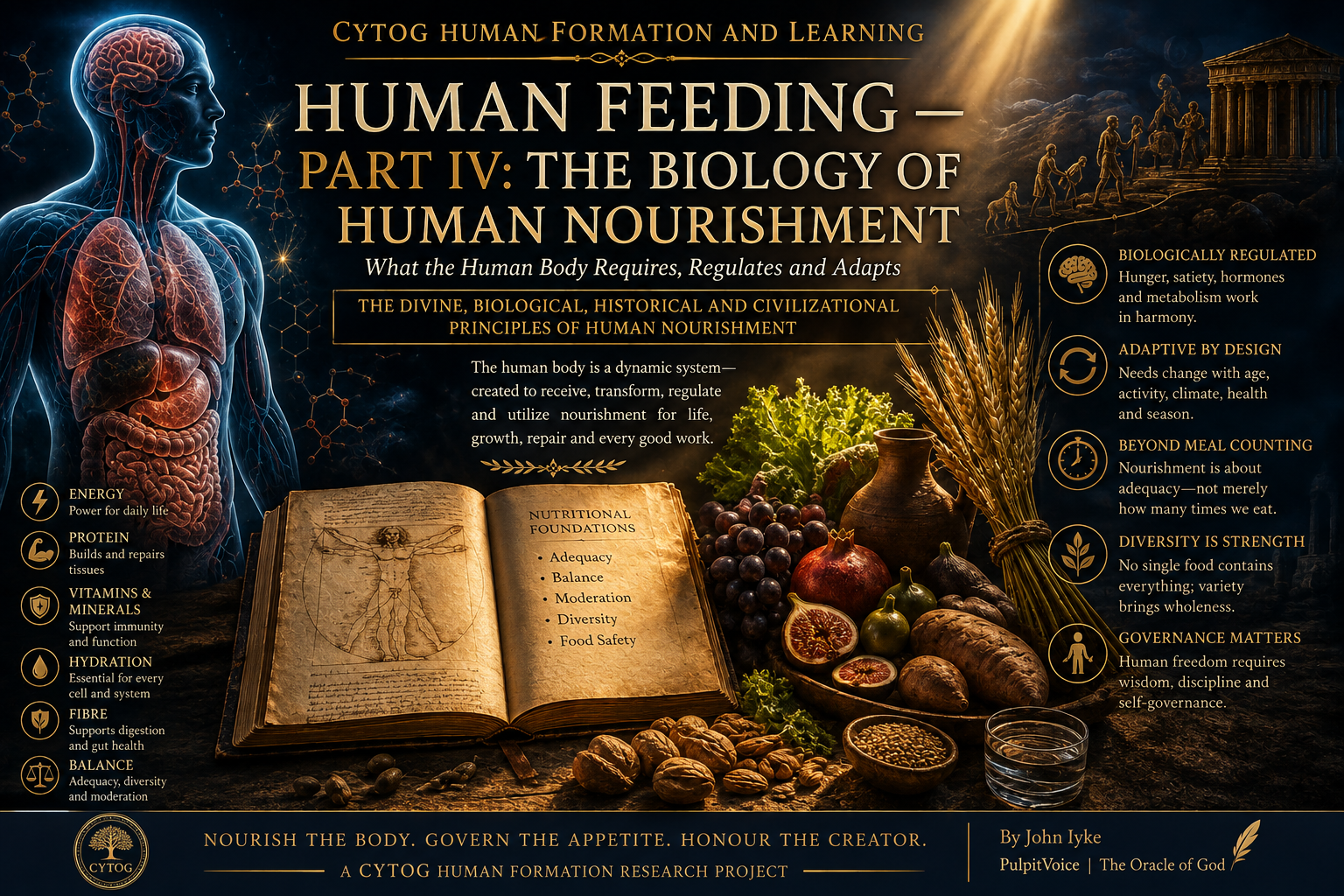
HUMAN FEEDING
THE BIOLOGY OF HUMAN NOURISHMENT
The biblical investigation establishes an important theological boundary: the fact that God fed Elijah at particular times does not, by itself, establish a universal human meal schedule.
We must therefore now ask a different question:
What does the human organism actually require in order to live, grow, repair itself, function and remain healthy—and how flexible is the human body concerning the timing, quantity and composition of food?
This section is foundational because any proposed principle of human feeding must ultimately deal with the biological reality of the human body.
A theological proposition that ignores human physiology is incomplete.
A nutritional proposition that ignores human variation is equally incomplete.
The objective here is therefore not to discover a single biological “clock” that every human being must obey. It is to determine what is biologically necessary, what is biologically regulated, what is biologically flexible, and what becomes dependent upon individual circumstance.
Current WHO guidance is particularly useful as a starting framework because it identifies four foundational characteristics of a healthy diet: adequacy, balance, moderation and diversity, while also emphasizing food safety. WHO further states that the exact composition of a healthy diet varies according to characteristics such as age, sex, lifestyle, physical activity, cultural context and locally available foods.
That observation immediately gives us an important distinction:
Human nutritional requirements have biological foundations, but their practical expression is adaptable.
THE HUMAN BODY IS NOT MERELY A CONTAINER FOR FOOD
Food is commonly described as something that “gives us energy.”
That is true, but profoundly incomplete.
The human organism uses nutrients for several interconnected purposes: energy production; tissue construction; tissue repair; maintenance of organs; synthesis of hormones and enzymes; immune function; nervous-system function; fluid regulation; blood formation; bone maintenance; reproduction; growth and development; thermoregulation; and countless cellular processes.
The digestive system breaks food down into components that can be absorbed and used by the body. The small intestine absorbs most nutrients, which then enter circulation or other transport systems and are distributed for storage or use.
Consequently:
Human feeding is not simply the filling of hunger. It is the continuous provision of materials from which the body maintains and conducts life.
This distinction is fundamental.
A person can eat frequently and still be poorly nourished.
A person can eat relatively infrequently and still receive adequate nourishment.
Therefore:
Frequency of eating and adequacy of nourishment are not identical concepts.
This is one of the first major biological findings relevant to the Elijah question.
THE FIRST BIOLOGICAL REQUIREMENT: ADEQUACY
The most fundamental nutritional question is not “How many times did you eat today?”
It is “Did your total intake adequately supply what your body required?”
WHO defines dietary adequacy in terms of meeting, without exceeding, macro- and micronutrient needs sufficiently to prevent deficiencies.
Adequacy therefore concerns the relationship between human requirements and nutrient intake.
A diet can fail through deficiency. It can also fail through excess.
Therefore, adequate feeding does not mean “Eat as much as possible.”
It means: Provide the body with sufficient essential nourishment without systematically exceeding what it requires.
This immediately introduces a distinction between sufficiency and abundance.
A person may have abundant food but inadequate nutrition. Another person may have a relatively simple diet that nevertheless supplies sufficient nourishment.
Thus:
The biological goal of feeding is not maximum consumption but adequate nourishment.
ENERGY: THE BODY HAS A CONTINUOUS DEMAND
The body is constantly expending energy.
Energy is required even when a person appears to be doing nothing.
The body must maintain: breathing; circulation; nervous-system activity; cellular metabolism; temperature regulation; organ function; tissue maintenance.
This underlying expenditure is commonly described through basal metabolic requirements or basal metabolic rate.
Beyond this baseline, total energy expenditure is influenced by: resting metabolic requirements; physical activity; the thermic effect of food; physiological states; growth; pregnancy and lactation; illness and recovery; and other individual circumstances.
Modern metabolic research recognizes energy regulation as a dynamic interaction involving food intake, diet composition, appetite, satiety, body composition, physical activity, thermogenesis and hormonal signals.
Therefore, the human feeding question cannot be reduced to a fixed quantity applicable to every person.
The energy requirement of a sedentary office worker, a manual labourer, a long-distance athlete, a growing adolescent, an elderly person, a pregnant woman, and a person recovering from illness will not necessarily be identical.
Biological proposition:
Human feeding must ultimately correspond to the body’s changing requirements rather than to a single quantity imposed uniformly upon every person.
HUNGER: THE BODY’S SIGNAL FOR FOOD SEEKING
Hunger is one of the most recognizable biological signals involved in feeding.
But hunger is not simply an empty stomach.
The regulation of eating involves communication between the gastrointestinal tract; the nervous system; the brain; hormones; nutrient availability; energy stores; environmental signals; and learned behaviour.
NIDDK research describes an extensive gut-brain system involving neural pathways, nutrient sensing and hormones that participate in hunger, satiety and energy regulation.
This is important because it demonstrates that feeding behaviour is biologically regulated.
The body does not merely wait for a clock to announce “It is 8:00 a.m.; therefore you must eat.”
Nor is hunger the only determinant of eating.
Food can be consumed because of: habit; social expectation; availability; pleasure; emotional cues; environmental cues; cultural practice; or scheduled routines.
Therefore, we must distinguish “physiological hunger” from “the desire to eat.” They overlap, but they are not identical.
SATIETY: THE BODY ALSO KNOWS WHEN TO STOP
If hunger encourages food seeking, satiety helps regulate termination of eating.
The gastrointestinal tract communicates with the brain through mechanical and chemical signals. Hormonal and neural systems participate in signaling fullness and regulating food intake.
This gives us an important biological pair: “Hunger encourages initiation of feeding.” “Satiety contributes to termination of feeding.”
The human feeding system therefore contains mechanisms for both “I need food” and “I have had enough.”
This has enormous implications for the eventual CYTOG principle.
Human nourishment is not merely about acquiring food. It is also about governing intake.
The biological system supplies signals, but human beings can also override those signals through habit, culture, pleasure, social pressure and deliberate behaviour.
Thus:
Human feeding involves both biological regulation and behavioural governance.
DIGESTION: FOOD MUST BE TRANSFORMED BEFORE IT CAN NOURISH
Eating is only the beginning.
Food must be: ingested → mechanically processed → chemically digested → absorbed → transported → metabolized → utilized or stored.
The digestive tract performs specialized functions throughout this process.
The mouth begins mechanical and chemical processing. The stomach mixes food with digestive secretions. The small intestine completes much of the digestion and absorbs nutrients. The large intestine participates substantially in water absorption and contains microbial processes that contribute to the breakdown of remaining material.
This leads to an important distinction:
Food is not identical to nourishment.
Food becomes nourishment only insofar as the body can digest, absorb, metabolize and utilize what it contains.
This is why food quality matters.
Two foods may contain similar amounts of calories while differing substantially in: protein; fibre; vitamins; minerals; fatty-acid composition; bioactive compounds; degree of processing; and effects on satiety.
Therefore:
Calories alone cannot fully define nutritional adequacy.
GLUCOSE REGULATION
Glucose is a major energy substrate, particularly important for the brain and other tissues.
When carbohydrate-containing foods are digested, glucose and other simple sugars become available for absorption.
The body regulates blood glucose through coordinated metabolic and hormonal processes, including insulin and other hormones.
The pancreas is central to this regulation.
The liver also plays an important role in storing, processing and releasing nutrients.
The body’s nutrient-sensing system is considerably more sophisticated than simply measuring whether a person has recently eaten. NIDDK research describes interactions involving insulin, leptin, ghrelin, GLP-1 and other metabolic and appetite-regulating signals.
This demonstrates another principle:
The body possesses internal mechanisms for managing nutrients between periods of eating.
Food does not have to be continuously entering the stomach for metabolism to continue.
The body can: use nutrients immediately; store energy; mobilize stored energy; regulate circulating nutrients; and adapt to periods between meals.
This does not establish that prolonged fasting is automatically beneficial.
It establishes something narrower and more important:
The human metabolic system is capable of functioning across intervals between food intake.
Therefore, the existence of intervals without food is not itself biologically abnormal.
PROTEIN: BUILDING AND REPAIR
Protein is fundamentally different from simply supplying calories.
Proteins provide amino acids required for: tissue maintenance; muscle; enzymes; hormones; immune components; structural proteins; growth; and repair.
The body’s protein requirements vary with circumstances.
Requirements are influenced by factors including: body size; age; growth; physical activity; pregnancy; lactation; illness; injury; and other physiological states.
Therefore:
A feeding system must provide adequate protein over time, while recognizing that individual requirements differ.
The important point for our project is that nutritional adequacy cannot be judged merely by asking how many meals were consumed.
A person could eat three meals deficient in protein. Another could consume two nutritionally adequate meals.
The number alone does not answer the nutritional question.
CARBOHYDRATES: A MAJOR ENERGY SOURCE
Carbohydrates are an important source of energy.
WHO identifies carbohydrates as the body’s primary energy source and recommends that, for most people, carbohydrates come substantially from less-refined sources such as whole grains, vegetables, fruits and pulses. Current WHO guidance gives a broad range rather than requiring a single fixed carbohydrate intake for everyone.
This is significant.
It demonstrates that even a major macronutrient does not have to be interpreted through one universal food item.
The human body can receive carbohydrate from many food systems: grains; roots; tubers; fruits; legumes; vegetables; and other sources.
This becomes particularly important when we later compare: biblical foods; African food traditions; Asian food systems; European diets; indigenous diets; and modern industrial diets.
The biological requirement is not necessarily identical to one civilization’s food vocabulary.
FATS: ENERGY, STRUCTURE AND ABSORPTION
Dietary fats serve several functions.
They provide energy and participate in cellular structure and physiological processes. Certain fatty acids are essential because the body cannot synthesize them in sufficient quantities.
Fat also assists absorption of fat-soluble vitamins.
But quantity and type matter.
WHO recommends limiting total fat within the overall diet and, importantly, shifting the composition away from saturated and industrial trans fats toward healthier unsaturated fats.
Therefore, “fat” is not a single nutritional category in practical terms.
The relevant question becomes: What type, how much and in what overall dietary context?
Again, this reinforces the principle of balance rather than simplistic prohibition.
FIBRE: THE OFTEN-NEGLECTED COMPONENT
Dietary fibre is another major component of healthy eating.
WHO’s current guidance recommends naturally occurring dietary fibre from foods, with adults and children over ten generally aiming for at least 25 grams daily.
Fibre is obtained substantially from: vegetables; fruits; whole grains; pulses; nuts; seeds; and other plant foods.
This matters for the broader CYTOG investigation because many traditional food systems are naturally built around combinations of: staples + legumes + vegetables + fruits + seeds/nuts + animal foods where available.
The biological value of a diet therefore often lies not in one “perfect food” but in the relationship among different food groups.
VITAMINS AND MINERALS: SMALL QUANTITIES, LARGE CONSEQUENCES
Micronutrients are required in smaller quantities than macronutrients, but their importance is enormous.
They participate in: blood formation; bone development; immune function; neurological function; metabolism; hormone production; antioxidant systems; cellular processes; growth; reproduction.
Deficiencies can produce serious consequences. Excesses can also be harmful for certain nutrients.
This reinforces the concept of adequacy without excess.
A diet can provide plenty of calories while failing to provide sufficient micronutrients.
This is one reason WHO emphasizes dietary diversity. A varied diet increases the likelihood of meeting vitamin and mineral requirements.
Biological proposition:
Human nourishment requires nutritional sufficiency, not merely caloric sufficiency.
That distinction should become a permanent part of the CYTOG framework.
HYDRATION
Food is not the only daily necessity.
Water is fundamental to life.
It participates in: circulation; temperature regulation; digestion; cellular processes; waste removal; and numerous physiological functions.
The amount required varies.
Hydration needs are affected by: climate; physical activity; body size; illness; sweating; pregnancy; lactation; diet; and other circumstances.
Therefore, just as nutritional requirements vary, fluid requirements vary.
A person working physically in a hot environment may require substantially more fluid than a person sitting quietly in a cool environment.
This illustrates a broader principle:
Human nourishment is responsive to circumstance.
SLEEP AND EATING
Food and sleep are not isolated biological systems.
Human metabolism, appetite and nutrient handling interact with circadian biology.
NIDDK research explicitly identifies interactions between circadian rhythms, nutrient sensing, food intake and metabolic pathways.
This does not mean that there is one universally correct clock time at which every human being should eat.
It means that the timing of food can interact with the body’s biological rhythms.
This opens an important research area for the later meal-timing section.
We will eventually need to examine: daytime versus nighttime eating; sleep duration; shift work; irregular schedules; late-night eating; circadian rhythms; and time-restricted eating.
But we must not jump prematurely from “Timing interacts with biology” to “Therefore everyone must eat at exactly the same times.”
The evidence does not justify that leap.
PHYSICAL ACTIVITY
Human feeding requirements are strongly connected with physical activity.
A person who expends more energy through physical work or exercise may require greater energy and, depending on circumstances, different nutritional strategies.
Consider the difference between: a farmer working physically all day; a construction worker; a professional athlete; a soldier; an office worker; a retired person; and a person confined to bed because of illness.
It would be biologically unreasonable to assume that identical food quantities and schedules are optimal for all of them.
This gives us an important principle:
Food requirements are partly functions of what the body is being asked to do.
The body is not merely an organism with a fixed requirement.
It is an adaptive organism operating under changing demands.
AGE: THE HUMAN BODY CHANGES THROUGH LIFE
A newborn does not have the nutritional requirements of an adult.
A child does not have the requirements of an elderly person.
Human nutritional needs change across the life course.
Important stages include:
Infancy — Rapid growth and development create distinctive nutritional requirements. WHO emphasizes that healthy dietary practice begins early in life and that breastfeeding supports healthy growth and development.
Childhood — Growth, development, activity and brain maturation create substantial nutritional demands.
Adolescence — Rapid physical growth and developmental changes alter requirements.
Adulthood — Requirements become strongly influenced by body composition, activity, occupation and health.
Older adulthood — Changes in muscle mass, appetite, digestion, activity and disease burden can alter nutritional needs.
Therefore:
There cannot be a single human feeding formula that ignores the life stage of the person.
SEX AND PHYSIOLOGICAL DIFFERENCES
Biological sex can influence nutritional requirements through differences in: body composition; average energy expenditure; reproductive physiology; iron requirements; pregnancy; lactation; and other physiological factors.
This does not mean that every man requires more food than every woman.
Individual variation can be substantial.
The correct biological principle is therefore:
Sex can influence nutritional requirements, but individual physiology remains important.
That distinction prevents simplistic rules.
PREGNANCY AND LACTATION
Pregnancy changes the nutritional environment substantially.
The mother is supporting both her own physiological needs and the development of a fetus.
Lactation subsequently creates additional nutritional and energy demands associated with milk production.
Therefore:
A feeding principle that treats the adult human body as biologically static is inadequate.
Pregnancy and lactation demonstrate that human nutritional requirements can change dramatically according to reproductive state.
This will eventually become important for the question: “Should everyone eat according to the same daily pattern?”
Biologically, the answer is already becoming difficult to sustain.
CHILDHOOD AND THE PROBLEM OF UNIVERSAL ADULT RULES
Children deserve particular attention because their bodies are growing.
The nutritional objective is not simply to maintain an existing body.
It is to support: growth; tissue development; brain development; bone formation; immune maturation; physical activity; and learning.
Therefore, a principle derived from the feeding pattern of an adult prophet cannot simply be transferred to children without further evidence.
This is another reason why the Elijah narrative cannot be treated as a universal biological dietary law.
Elijah was an adult man in a specific circumstance.
The biological population called “human beings” includes: infants; children; adolescents; adults; pregnant women; breastfeeding women; older adults; athletes; manual workers; sedentary people; and people living with disease.
A universal feeding principle must account for this diversity.
AGEING
Ageing introduces another dimension of nutritional adaptation.
As people age, several factors can change: energy expenditure; muscle mass; appetite; physical activity; nutrient absorption; dental function; thirst perception; disease burden; medication use; and food access.
Consequently, the nutritional challenge may change from simply obtaining enough calories to obtaining nutrient-dense nourishment within changing energy requirements.
This supports an important principle:
The quantity of food required can change even when the need for nutritional adequacy remains.
Thus: less energy required does not equal less need for nutrients.
ILLNESS
Illness can profoundly alter nutritional requirements.
Depending on the condition, illness may: increase metabolic demands; reduce appetite; impair digestion; impair absorption; alter fluid requirements; change protein requirements; alter glucose metabolism; or require medically prescribed dietary changes.
This establishes another limitation against universal feeding formulas.
A healthy adult and a person undergoing significant illness may require fundamentally different nutritional strategies.
Therefore:
A sound general feeding principle must be capable of adaptation without abandoning its foundational objectives.
CLIMATE
Climate affects the human organism and therefore can affect food and fluid requirements.
Hot environments increase heat stress and fluid losses.
Cold environments can alter energy demands and behaviour.
Seasonal environments can also influence: food availability; preservation; agricultural production; traditional diets; activity patterns; and cultural eating practices.
This becomes particularly important when we later investigate civilization.
Traditional food systems did not develop in a vacuum.
Human beings learned to feed themselves within: climate + ecology + agriculture + season + culture + technology.
Thus:
Human feeding has always been partly adaptive to environment.
OCCUPATIONAL DEMANDS
Occupation can dramatically influence feeding requirements.
A person whose daily life consists primarily of sitting may have very different energy expenditure from someone performing: farming; construction; fishing; forestry; mining; military work; long-distance transport; professional sport; or other heavy physical labour.
Historically, this distinction would have been even more pronounced in societies without mechanized transport and industrial automation.
This means that the question “How much should a human being eat?” cannot be answered adequately without asking “What does that human being do?”
THE BIOLOGICAL SIGNIFICANCE OF DIVERSITY
The human body requires numerous nutrients.
No single ordinary food naturally provides everything in the quantities required for every person.
Therefore, dietary diversity becomes biologically meaningful.
WHO identifies diversity as one of the four foundational principles of a healthy diet and notes that diverse diets increase the likelihood of meeting vitamin and mineral requirements.
This suggests a powerful principle for our research:
Human beings require nutritional completeness, and nutritional completeness is generally achieved through dietary pattern rather than dependence upon a single food.
This will become particularly valuable when we compare biblical, traditional African and modern food systems.
BALANCE: ENERGY IN RELATION TO ENERGY OUT
A healthy feeding system must also consider energy balance.
WHO defines dietary balance partly in terms of balancing total energy intake with expenditure and maintaining an appropriate relationship among protein, fats and carbohydrates.
This gives us a useful conceptual equation:
Food intake must be considered in relation to bodily demand.
Too little over time can result in: undernutrition; inadequate growth; tissue loss; impaired function; nutrient deficiencies.
Too much over time can contribute to: excessive weight gain; metabolic problems; and increased risk of diet-related disease.
Therefore:
Neither chronic excess nor chronic deficiency represents sound nourishment.
Moderation is consequently not merely a moral concept. It has a biological dimension.
MODERATION IS NOT STARVATION
This distinction is essential.
If we later use the term moderation, we must not allow it to become synonymous with eating as little as possible.
Moderation means avoiding inappropriate excess while still meeting biological requirements.
WHO’s framework explicitly places moderation alongside adequacy, balance and diversity.
Therefore:
A person who chronically underfeeds himself is not practicing healthy moderation merely because he eats less.
Likewise:
A person who continually overeats is not practicing healthy abundance merely because food is available.
The biological principle lies between deficiency and excess.
THE QUESTION OF MEAL FREQUENCY
We have now reached the most important point for our Elijah investigation.
Does biology require one meal? two meals? three meals? five meals? continuous grazing?
The evidence assembled so far does not establish one universal number.
What biology clearly establishes is that the body requires: adequate energy; adequate protein; adequate essential fats; appropriate carbohydrate; vitamins; minerals; fibre; water; and other necessary nutrients.
The exact way these requirements are distributed across the day can vary.
This distinction is crucial.
Biological requirement: Adequate nourishment.
Biological variable: How that nourishment is distributed across eating occasions.
Therefore:
The existence of biological nutritional requirements does not automatically imply one universally mandatory meal frequency.
This does not mean meal timing is irrelevant.
It means meal timing must be investigated as a separate question.
THE BODY’S FLEXIBILITY
Human beings possess considerable physiological adaptability.
The body can respond to: periods between meals; changes in food availability; changes in activity; changes in energy intake; changes in environmental conditions; and changes in life stage.
This does not mean every dietary pattern is equally healthy.
It means the human organism is not so rigid that missing a meal automatically constitutes biological failure.
The body has mechanisms for mobilizing stored energy and regulating metabolism between food intake periods.
Therefore:
Human biology permits intervals without eating.
But this must not be transformed into: Therefore longer fasting is always better. That conclusion requires separate evidence.
WHAT BIOLOGY SAYS ABOUT THE CLOCK
We can now make a careful distinction.
The body has rhythms. Yes.
Food timing can interact with those rhythms. Yes.
Hunger and satiety have biological regulation. Yes.
Metabolism responds to timing and food composition. Yes.
Therefore every person must eat at exactly the same times. No such conclusion has been established.
This distinction is extremely important for the final CYTOG principle.
A biological rhythm is not necessarily a universal clock schedule.
The human body operates through interacting systems rather than one simple timer.
BIOLOGY AND THE CONCEPT OF ADAPTATION
One of the strongest findings emerging from this section is adaptation.
Human nutritional needs adapt to: age; growth; sex; pregnancy; lactation; activity; occupation; climate; illness; body size; physiological condition; food availability; lifestyle.
Therefore, any legitimate universal principle of human feeding must be broad enough to accommodate legitimate variation.
This suggests a distinction between “Universal nutritional principles” and “Variable nutritional applications.”
For example:
Universal principle: “The human body requires adequate nourishment.”
Variable application: “The quantity and distribution of food required to achieve adequacy differ among people and circumstances.”
That distinction may eventually become central to the CYTOG framework.
THE BIOLOGICAL HIERARCHY OF HUMAN FEEDING
Our investigation now allows us to construct a preliminary hierarchy.
LEVEL 1 — SURVIVAL: The body must receive sufficient energy, water and essential nutrients to sustain life.
LEVEL 2 — MAINTENANCE: The body requires nutrients for tissue maintenance, metabolism, immunity and normal physiological function.
LEVEL 3 — GROWTH AND DEVELOPMENT: Children, adolescents and developing humans have additional requirements.
LEVEL 4 — PERFORMANCE: Physical activity, occupation, sport and other demands alter requirements.
LEVEL 5 — REPRODUCTION: Pregnancy and lactation create distinctive nutritional demands.
LEVEL 6 — RECOVERY: Illness, injury and physiological stress can alter nutritional requirements.
LEVEL 7 — LONG-TERM HEALTH: The quality, balance, diversity and moderation of the diet influence health across the life course.
This hierarchy is more biologically defensible than beginning with “How many meals should I eat?” Because meal frequency appears much further down the chain.
A CRITICAL RESEARCH FINDING
We can now state something with considerable confidence:
The biological problem of human feeding is fundamentally a problem of nutrient adequacy, energy balance, physiological regulation and adaptation—not merely a problem of meal counting.
This does not make meal frequency irrelevant.
It puts meal frequency in its proper place.
The order of inquiry should therefore be:
What does the body require? → How much does this individual require? → What foods can provide those requirements? → How should those foods be combined? → How should intake be distributed? → What timing best fits the individual and circumstances?
This is much stronger than beginning with a predetermined number of meals.
BIOLOGICAL PROPOSITIONS ESTABLISHED SO FAR
Proposition 1: “Human beings require food-derived nutrients to supply energy, support growth, maintain tissues and conduct physiological functions.” Status: Strongly established.
Proposition 2: “Adequate nourishment requires more than calories; it requires appropriate macro- and micronutrient sufficiency.” Status: Strongly established.
Proposition 3: “Human feeding is biologically regulated through interacting hunger, satiety, hormonal, neural and metabolic systems.” Status: Strongly established.
Proposition 4: “Human nutritional requirements vary according to individual and physiological circumstances.” Status: Strongly established. WHO explicitly identifies age, sex, lifestyle and physical activity among factors affecting dietary composition.
Proposition 5: “Human beings can metabolically function across intervals between meals.” Status: Established as a physiological capacity; the health effects of different fasting durations require separate investigation.
Proposition 6: “Meal frequency is not identical to nutritional adequacy.” Status: Strong inference from the distinction between nutrient requirements and eating occasions; requires dedicated meal-frequency research before stronger conclusions.
Proposition 7: “No single universal meal frequency has been established by the evidence examined in this section as the biological requirement for all humans.” Status: Preliminary research finding.
This proposition must be tested more deeply in Part XI, where meal timing, fasting and frequency will receive dedicated treatment.
THE EMERGING BIOLOGICAL PRINCIPLE
At this stage, the strongest biological formulation is:
A human being should receive sufficient, safe and nutritionally diverse food to meet the body’s requirements for energy, growth, maintenance, repair and physiological function, while the quantity, composition and distribution of that nourishment should be capable of adapting to age, sex, physical activity, reproductive state, health, environment and other legitimate individual circumstances.
This is considerably stronger than “A human being should eat three times a day.”
And it is also more defensible than “A human being should eat twice a day because Elijah did.”
The biological evidence points us toward adequacy + balance + moderation + diversity + adaptation, rather than a universal numerical meal rule. WHO independently arrives at four of those foundational concepts—adequacy, balance, moderation and diversity—while recognizing variation in practical dietary composition.
THE CONNECTION BACK TO ELIJAH
We can now return to our original case.
Elijah received “bread and meat in the morning and evening.”
Biologically, we can say:
A human being can obtain nourishment through food distributed across two daily eating occasions.
Nothing in human physiology makes the mere existence of two eating occasions inherently impossible.
But biology does not give us permission to reverse the argument:
Elijah ate twice daily → therefore two meals are biologically optimal for everyone.
That would be scientifically unjustified.
Likewise:
Some people eat three times daily → therefore three meals are divinely ordained.
That would be equally unjustified.
The biological evidence therefore reinforces the theological conclusion already reached:
Elijah’s two daily feedings can be treated as an authentic biblical example without being elevated into a universal biological law.
PRELIMINARY CYTOG BIOLOGICAL PRINCIPLE
The research can now tentatively formulate the biological foundation of HUMAN FEEDING as follows:
Human nourishment should be governed first by adequacy of nutrients and energy, quality and diversity of food, moderation of intake, physiological need and adaptation to circumstance—not by an assumed universal number of daily meals.
Or, in a more developed form:
The human being should feed in a manner that adequately nourishes the body, supports its maintenance, growth, repair and activity, supplies essential nutrients and water, avoids chronic deficiency and excess, and adapts the quantity, composition and timing of food to the person’s changing physiological and environmental circumstances.
This is not yet the final CYTOG principle.
It is the biological foundation upon which the final principle must be built.
WHAT REMAINS UNRESOLVED
The biological investigation has answered some questions, but it has deliberately left others open.
We still need to investigate deeply:
- How many meals per day are associated with better health outcomes?
- Is two meals biologically sufficient for most healthy adults?
- Is three meals merely a cultural convention or does it possess biological advantages?
- Does eating according to hunger produce better outcomes than eating according to a clock?
- What does the evidence say about breakfast?
- What does the evidence say about late-night eating?
- What does the evidence say about time-restricted eating?
- What happens during prolonged fasting?
- Does meal frequency affect glucose regulation independently of total food intake?
- How does meal frequency interact with sleep and circadian rhythm?
- How do traditional human populations distribute food across the day?
- How did pre-industrial societies feed themselves when food availability was seasonal or uncertain?
- What can biblical meal patterns tell us when compared with broader historical evidence?
- Can one principle govern feeding while allowing different practical schedules?
Those questions must not be answered by assumption.
They require their own evidence.
INTERIM CONCLUSION
The biological investigation has moved our central question forward considerably.
The human body clearly requires nourishment, but nourishment is larger than meal frequency.
The body requires: energy; protein; fats; carbohydrates; fibre; vitamins; minerals; water; and numerous other essential nutritional components.
It also possesses sophisticated systems regulating: hunger; satiety; digestion; nutrient absorption; glucose regulation; energy expenditure; metabolism; and appetite.
And these requirements and processes are not identical across every human being.
They change with: age; growth; sex; pregnancy; lactation; activity; occupation; illness; climate; ageing; and other circumstances.
Therefore, the strongest biological conclusion presently available is:
There is a universal human need for adequate nourishment, but there is not yet evidence here for a universal human feeding schedule.
That distinction is crucial.
It means the ultimate CYTOG principle may need to distinguish between “What every human being needs” and “How each human being may appropriately organize the provision of what he or she needs.”
The first may be universal.
The second may be adaptive.
And that distinction may eventually provide the bridge between God’s provision, human biology, historical feeding patterns and the practical question of how a human being should eat every day.
Leave a Reply