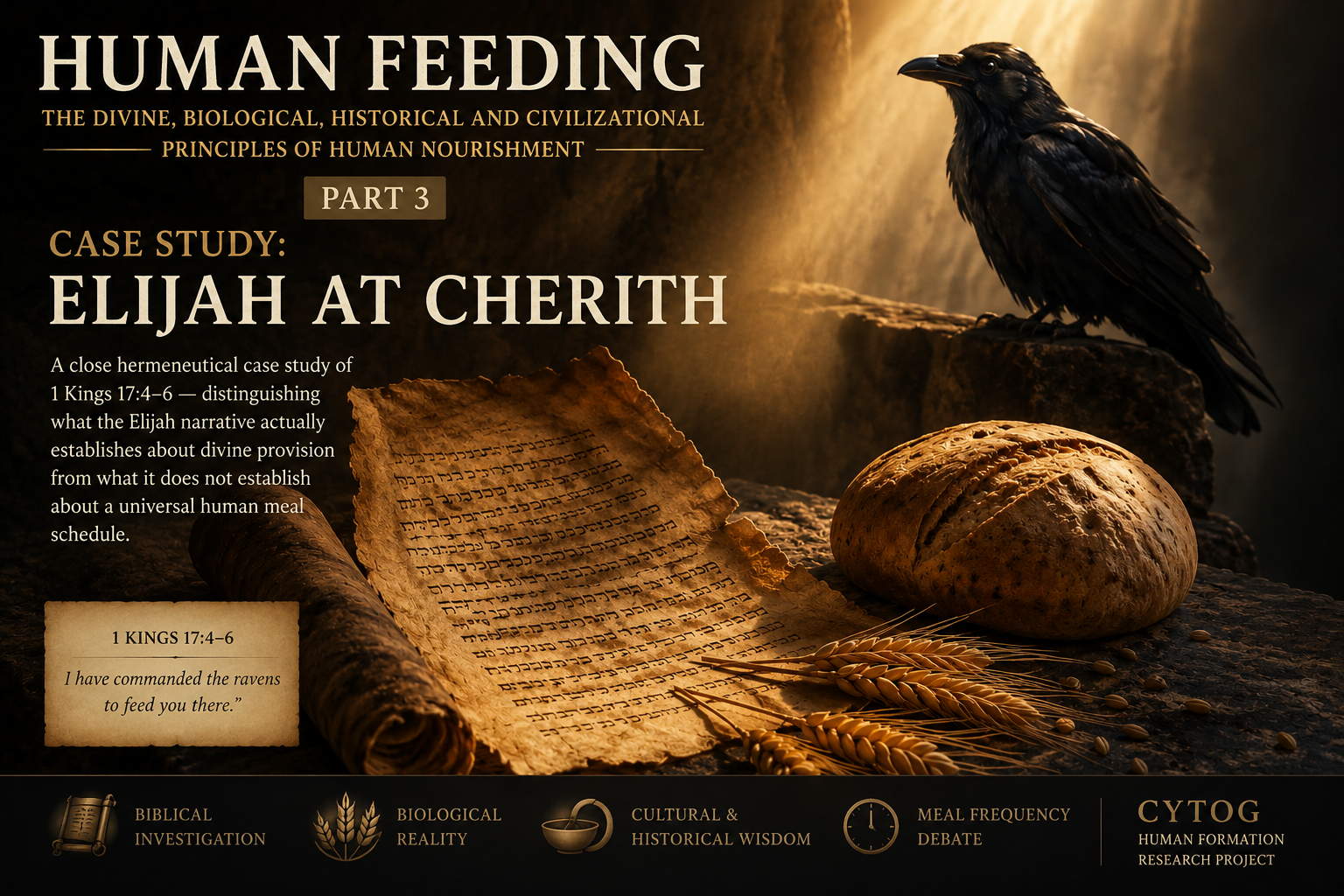
HUMAN FEEDING
CASE STUDY: ELIJAH AT CHERITH
Proposition
God provided food for Elijah at the brook Cherith, and the biblical narrative specifically records that the food arrived in the morning and in the evening.
This is not an inference. It is the explicit statement of the text.
In 1 Kings 17:4, God tells Elijah that He has commanded the ravens to feed him at the brook. Elijah obeys, and verse 6 records that the ravens brought him bread and meat “in the morning” and “in the evening,” while he drank from the brook.
The passage therefore provides genuine biblical evidence for a human being receiving food twice within the day.
The question, however, is not whether Elijah received food morning and evening.
The question is what theological conclusion may legitimately be drawn from that fact.
THE IMMEDIATE CONTEXT OF ELIJAH’S FEEDING
The account cannot be isolated from the circumstances surrounding it.
1 Kings 17 begins with Elijah announcing to King Ahab that there would be no dew or rain in Israel except according to his word. Immediately afterward, the word of the LORD directs Elijah away from the public sphere:
“Go away from here, turn eastward and hide yourself by the brook Cherith.”
God then specifies three things concerning Elijah’s immediate survival:
- His location — the brook Cherith.
- His water supply — the brook.
- His food supply — the ravens.
The sequence is important.
Elijah does not independently devise a dietary programme.
He does not choose two meals because he has concluded that two meals constitute the divinely ordained human schedule.
Rather, God gives Elijah a specific command concerning where he is to go and how he will be sustained there.
The text then says:
“So he went and did according to the word of the LORD.”
This establishes the governing relationship:
Divine instruction → Elijah’s obedience → divine provision.
The morning-and-evening pattern appears within that larger providential arrangement.
WHAT EXACTLY DOES THE TEXT SAY?
The relevant sequence is remarkably precise.
Verse 4: God says that Elijah will drink from the brook and that He has commanded the ravens to feed him there.
Verse 5: Elijah obeys the word of the LORD and lives by the brook.
Verse 6: The ravens bring Elijah bread and meat in the morning and bread and meat in the evening, and Elijah drinks from the brook.
Verse 7: Eventually, the brook dries up because there has been no rain in the land.
Verse 8–9: God then gives Elijah another instruction: he must leave Cherith and go to Zarephath, where God says that a widow will sustain him.
This progression is extraordinarily important for our research.
The method of provision changes.
At Cherith: Ravens provide the food.
At Zarephath: A widow provides the food.
Therefore, even within the same prophetic episode, God’s provision does not remain attached to one permanent human feeding mechanism.
That observation will become important when we distinguish the principle of divine provision from the particular form that provision takes.
FIRST CLASSIFICATION: DIVINE PROVISION
Finding: YES
The passage unquestionably represents divine provision.
God explicitly tells Elijah that He has commanded the ravens to feed him. The provision is therefore presented as originating in God’s command and providence.
The food itself is not presented as Elijah’s achievement.
He is not farming. He is not hunting. He is not purchasing food. He is not gathering grain. He is not preparing a conventional household meal.
He is living under an extraordinary arrangement in which God provides his food while he remains in hiding.
Principle established:
God is capable of sustaining a human being through means that He Himself appoints.
This is a legitimate theological principle.
But it is broader than meal frequency.
The text teaches something about God’s ability and willingness to provide for Elijah before it teaches anything about a universal human eating schedule.
SECOND CLASSIFICATION: DIVINE COMMAND
Finding: YES — BUT WITH AN IMPORTANT QUALIFICATION
There is a divine command in the passage.
God commands Elijah: where to go; where to stay; what water source to use; and that the ravens will feed him there.
The command is therefore genuine and personal.
But we must identify the object of the command.
God does not say:
“‘All human beings shall eat in the morning and in the evening.’”
Nor does He say:
“‘You shall establish morning and evening as the universal human meal pattern.’”
The command concerns Elijah’s particular situation.
The textual structure is:
“‘You [Elijah] shall drink from the brook … I have commanded the ravens to feed you there.’”
The pronoun and context matter.
The instruction is directed to a particular person in a particular location during a particular prophetic assignment.
Therefore: Divine command? Yes. Universal dietary command? Not stated.
This distinction must remain intact.
THIRD CLASSIFICATION: NARRATIVE DESCRIPTION
Finding: YES
1 Kings 17:6 is fundamentally a narrative report of what happened.
The writer tells us what the ravens did: they brought Elijah bread and meat in the morning and evening.
The verse therefore gives us historical/narrative information about Elijah’s experience.
This matters because Scripture contains different literary forms.
A biblical narrative can tell us that something happened without automatically commanding every subsequent reader to reproduce the event.
For example, the fact that Elijah was fed by ravens does not mean that every believer should expect ravens to become his or her food suppliers.
The same reasoning must be applied to the timing.
If the narrative is not automatically a command concerning the method of provision, we cannot automatically convert its timing into a universal command concerning meal frequency.
Important distinction:
“This happened” is not automatically equivalent to “Everyone must do this.”
That is a basic hermeneutical safeguard.
FOURTH CLASSIFICATION: DIVINE PRINCIPLE
Finding: YES — BUT THE PRINCIPLE IS BROADER THAN THE SCHEDULE
The account can legitimately yield divine principles.
For example:
Principle 1 — God provides for His servants. Elijah’s survival during the drought is attributed to God’s provision.
Principle 2 — Divine provision may operate through unexpected means. The means appointed for Elijah are ravens.
Principle 3 — Human beings are dependent upon provision beyond their own control. Elijah cannot manufacture rain or create his own food supply at Cherith.
Principle 4 — Obedience and provision are connected within the narrative. Elijah goes where God tells him to go, and God provides there.
Principle 5 — The form of divine provision can change according to circumstance. The ravens provide at Cherith; later, a widow sustains Elijah at Zarephath.
But what about: “God’s principle is two meals a day”?
That is a much stronger proposition.
The text does not explicitly state it.
Therefore we must not confuse “A principle demonstrated through an event” with “A specific detail of the event being elevated into the universal principle.”
This distinction is central to the entire HUMAN FEEDING project.
FIFTH CLASSIFICATION: UNIVERSAL HUMAN LAW
Finding: NO — NOT FROM THIS PASSAGE
There is no statement in 1 Kings 17:4–6 that establishes:
“Every human being should eat twice a day.”
There is no universal subject. There is no universal command. There is no statement concerning humanity as a whole. There is no subsequent interpretation saying that Elijah’s schedule constitutes the divinely ordained human feeding schedule.
The text simply reports what happened to Elijah.
Therefore:
“1 Kings 17:4–6 cannot legitimately serve, by itself, as sufficient evidence for a universal two-meal-per-day law.”
That does not mean that two meals per day is wrong.
It means something more precise:
“The legitimacy of two meals per day must be established from a broader body of evidence rather than being inferred solely from Elijah.”
That evidence could eventually include: other biblical passages; broader biblical patterns; human physiology; nutritional science; historical meal patterns; cultural evidence; individual variation; and principles of appetite and self-governance.
That is the proper research pathway.
SIXTH CLASSIFICATION: INDIVIDUAL CIRCUMSTANCE
Finding: STRONGLY YES
Elijah’s circumstances are highly specific.
He is: a prophet; operating during a severe drought; under threat from the royal establishment; commanded to withdraw; living beside a particular brook; dependent upon supernatural provision; and subsequently relocated when the brook dries up.
This is not an ordinary domestic environment.
Elijah is not sitting at a family table deciding whether breakfast, lunch and dinner are necessary.
His food supply is determined by the unusual circumstances of his prophetic assignment.
Therefore, the contextual evidence strongly supports treating the feeding arrangement as circumstantial rather than automatically universal.
SEVENTH CLASSIFICATION: PROPHETIC EXCEPTION
Finding: STRONGLY SUPPORTED AS A CATEGORY
We should be careful with the word exception.
It would be too strong to claim that the Bible explicitly calls Elijah’s feeding pattern an “exception.” It does not.
But from a comparative biblical perspective, the event belongs to a category of extraordinary prophetic provision.
God sometimes sustains particular servants through unusual means.
Elijah himself provides an excellent example because his method of provision changes within the same chapter.
At Cherith: ravens. At Zarephath: a widow.
Later in Elijah’s life, another extraordinary feeding event occurs in 1 Kings 19, when an angel provides him with food during his journey. This demonstrates again that the Bible does not confine God’s provision to one fixed mechanism.
Therefore, we may cautiously classify Cherith as: “an extraordinary providential circumstance within Elijah’s prophetic vocation.”
That is stronger than merely calling it an ordinary dietary routine.
EIGHTH CLASSIFICATION: ORDINARY HUMAN PRACTICE
Finding: THE PASSAGE DOES NOT ESTABLISH THIS
This is perhaps the most important category for our original question.
We are asking:
“How should a human being ordinarily feed himself or herself every day?”
But Elijah’s Cherith experience does not tell us enough to answer that question.
The passage tells us: what food was brought; when it was brought; where Elijah received it; how it was supplied; and why the arrangement existed within the narrative.
But it does not tell us: that all people require two meals; that two meals are physiologically optimal; that breakfast and dinner are universally necessary; that lunch is contrary to God’s design; that eating more than twice daily is sinful; or that eating fewer than twice daily violates a divine law.
None of those conclusions can be extracted from this passage without importing additional assumptions.
THE MORNING-AND-EVENING DETAIL
Now we reach the heart of the question.
Why does the text specifically mention “morning” and “evening”?
This is not an insignificant detail.
The narrator deliberately records the timing.
Therefore, we should not dismiss it.
It establishes that Elijah’s provision occurred at two identifiable points in the day.
That gives us legitimate evidence that twice-daily feeding existed within the biblical world and could constitute a workable pattern of nourishment for Elijah under God’s provision.
But there are two different propositions:
Proposition A: “God fed Elijah in the morning and evening.” — Established.
Proposition B: “God therefore ordained morning-and-evening eating as the universal human feeding pattern.” — Not established by this passage.
The second proposition requires additional evidence.
THE MOST IMPORTANT LOGICAL DISTINCTION
We can express the reasoning formally.
Premise 1: God commanded that Elijah be fed at Cherith.
Premise 2: The ravens brought him food morning and evening.
Conclusion legitimately supported: “Elijah received food morning and evening by God’s providential arrangement.”
But if we add Premise 3 — which the passage does not state — “God intended Elijah’s feeding schedule to function as the universal schedule for humanity,” only then could we conclude: “Therefore all human beings should eat morning and evening.”
The problem is that Premise 3 has been inserted rather than demonstrated.
Therefore the universal conclusion does not follow from the text alone.
This is exactly the kind of reasoning discipline that HUMAN FEEDING requires.
DOES “MORNING AND EVENING” CARRY A BROADER BIBLICAL SIGNIFICANCE?
This question must not be ignored.
The Bible frequently uses morning and evening as meaningful divisions of the day. The creation account itself repeatedly uses evening and morning as temporal markers in Genesis 1.
Therefore, morning and evening are certainly recognizable biblical temporal categories.
But we must avoid another logical leap:
“‘Morning and evening are important biblical divisions of time’ therefore ‘Morning and evening are God’s universal appointed eating times.’”
That conclusion still does not follow.
The temporal vocabulary may establish when something happened without establishing that the same temporal arrangement constitutes a universal dietary command.
This distinction will become important when we later examine: manna; sacrifices; daily offerings; morning and evening prayer; morning and evening worship; daily bread; fasting; feasting; and meal practices in the New Testament.
Only after examining the whole biblical pattern can we determine whether a broader theological principle exists.
AN IMPORTANT OBSERVATION: GOD’S PROVISION CHANGES
The continuation of the narrative is particularly revealing.
After some time, the brook dries up.
Then God speaks again.
Elijah is instructed to go to Zarephath, where a widow has been commanded to sustain him.
This means that God’s provision for Elijah is dynamic.
The principle remains: Divine provision.
The mechanism changes: ravens → widow.
This distinction gives us a powerful theological model.
Constant principle: Divine provision.
Variable mechanism: The means through which provision occurs.
The same reasoning may eventually apply to human nourishment.
A principle of nourishment may be stable while the practical form varies according to: age; occupation; climate; activity; health; availability; culture; season; circumstance; and individual physiological requirements.
This does not prove that proposition yet.
But Elijah gives us a powerful conceptual distinction between principle and mechanism.
WHAT ABOUT THE FOOD ITSELF?
The text says the ravens brought “bread and meat.”
This is another important observation.
If we attempted to make every detail of Elijah’s feeding universally prescriptive, we would have to ask: Must everyone eat bread? Must everyone eat meat? Must both be eaten at each feeding? Must they be eaten twice daily? Must food arrive from outside the household? Must humans eat whatever food is providentially supplied?
Clearly, the narrative is not functioning as a universal dietary menu.
The fact that we instinctively recognize that bread and meat are descriptive details should make us cautious about turning the morning-and-evening detail into a universal command merely because it concerns timing.
The same interpretive discipline should apply to all details of the narrative.
WHAT THE ELIJAH ACCOUNT CAN LEGITIMATELY TEACH ABOUT HUMAN FEEDING
At this stage of the research, several propositions can responsibly be established.
Proposition 1 — Food is a legitimate object of divine provision. Elijah’s physical nourishment is explicitly included in God’s care.
Proposition 2 — Human beings are dependent creatures. Elijah cannot sustain himself independently of the environment and God’s provision.
Proposition 3 — The means of nourishment may vary. God uses ravens at Cherith and later a widow at Zarephath.
Proposition 4 — Food provision can be adapted to circumstance. Elijah’s feeding arrangement corresponds to his particular prophetic circumstances.
Proposition 5 — Twice-daily feeding is biblically attested. Elijah received food morning and evening.
Proposition 6 — Biblical attestation does not automatically establish universal prescription. The passage records Elijah’s experience but does not command humanity to reproduce his schedule.
Proposition 7 — God’s provision is more fundamental than the particular mechanism of provision. The narrative emphasizes God’s sustaining action rather than establishing a universal human timetable.
WHAT THE PASSAGE CANNOT LEGITIMATELY ESTABLISH BY ITSELF
The following propositions exceed the evidence of 1 Kings 17:4–6:
“God commands everyone to eat twice daily.” — Not established.
“Breakfast and dinner are God’s appointed meals.” — Not established.
“Lunch violates the biblical pattern.” — Not established.
“Eating three times a day is contrary to God’s design.” — Not established.
“Two meals are physiologically superior because Elijah ate twice.” — Not established.
“Every Christian should imitate Elijah’s meal schedule.” — Not established.
“Morning and evening constitute God’s universal eating timetable.” — Not established.
These claims may be investigated elsewhere.
But Elijah cannot be made to say more than Elijah says.
A CRUCIAL DISTINCTION FOR THE WHOLE HUMAN FEEDING PROJECT
The Elijah account teaches us something methodological that should govern our entire research.
We must distinguish:
EVENT — What happened? Elijah received food morning and evening.
COMMAND — What was Elijah instructed to do? Go to Cherith and remain there; God would provide his food.
PRINCIPLE — What broader truth may reasonably be derived? God can sustain human life and provide nourishment through His providence.
APPLICATION — How might a modern person live according to the principle? This requires additional reasoning and evidence.
UNIVERSAL LAW — What must every human being do? That cannot be established merely from Elijah’s narrative.
This five-level distinction should become one of the governing methodological principles of the entire CYTOG research.
PRELIMINARY RESEARCH VERDICT
Proposition: “God fed Elijah morning and evening at Cherith.” — Status: ESTABLISHED.
Proposition: “God specifically commanded Elijah concerning his provision at Cherith.” — Status: ESTABLISHED.
Proposition: “The morning-and-evening pattern was part of Elijah’s actual providential arrangement.” — Status: ESTABLISHED by the narrative.
Proposition: “The account demonstrates that twice-daily feeding can exist within a divinely provided pattern.” — Status: REASONABLE.
Proposition: “The account establishes two meals per day as a possible biblical feeding pattern.” — Status: REASONABLE.
Proposition: “The account establishes two meals per day as God’s universal human feeding law.” — Status: NOT ESTABLISHED.
Proposition: “The account establishes that human beings should ordinarily eat morning and evening.” — Status: NOT ESTABLISHED.
Proposition: “The account establishes divine provision as a theological principle.” — Status: STRONGLY ESTABLISHED.
Proposition: “The particular timing of Elijah’s meals should be treated as a universal dietary command.” — Status: UNSUPPORTED BY THIS PASSAGE ALONE.
THE PRELIMINARY CYTOG PRINCIPLE
We can therefore refine the original proposition.
“Elijah’s experience at Cherith demonstrates divine provision, not by itself a universal divine meal schedule.”
And more fully:
“The biblical account of Elijah at Cherith establishes that God provided physical nourishment for a particular human being according to a specific prophetic circumstance, with food supplied morning and evening. The morning-and-evening pattern is therefore a genuine biblical example of twice-daily feeding, but the passage does not itself transform that particular arrangement into a universal dietary law for humanity.”
This is presently the strongest conclusion that the passage itself can bear.
THE DEEPER QUESTION NOW BEFORE THE RESEARCH
The Elijah question should therefore not be closed yet.
Instead, Elijah has moved us to a much better question:
“Does the wider biblical canon reveal a recurring pattern in which human beings ordinarily receive and consume food in particular rhythms—morning, midday and evening, once, twice, or otherwise—and if so, does Scripture ever interpret those rhythms as divine principles?”
That requires us to examine the rest of Scripture comparatively.
We now need to test Elijah against: Genesis → Exodus → Leviticus → Deuteronomy → Ruth → Samuel → Kings → Psalms → Proverbs → Daniel → the Prophets → the Gospels → Acts → Paul → the Pastoral Epistles.
Only after that broader investigation can we responsibly determine whether Elijah is:
- an isolated prophetic circumstance;
- one example of a broader biblical two-meal pattern;
- evidence of a broader morning-evening rhythm;
- or simply one instance of God’s adaptable provision.
And this is where the research becomes substantially more interesting.
RESEARCH POSITION AFTER CASE STUDY
At this stage, we should not conclude:
“The Bible teaches two meals a day.”
Nor should we prematurely conclude:
“The Bible has nothing to say about meal frequency.”
The correct position is:
Elijah establishes that twice-daily feeding occurred under divine providence. It does not, by itself, establish the universality of that schedule. The question of whether it reflects a wider biblical pattern remains open and must be tested against the whole scriptural witness and, subsequently, against biological, historical and civilizational evidence.
That is the standard we should maintain throughout HUMAN FEEDING.
And importantly, this preserves both sides of the inquiry: we neither force a doctrine out of Elijah nor dismiss a potentially meaningful biblical pattern before investigating it.
Leave a Reply